


Environmental monitoring makes changes in cleanroom conditions visible through measurements and time-stamped records. A developing trend may provide warning before an action limit is reached, but some excursions are sudden and some events occur between samples. Monitoring is therefore a way to detect, assess and investigate change, not a guarantee that every deviation will be predicted or prevented.
Begin with the question each measurement can answer
Airborne particle counts describe particles detected within specified size channels and sample volumes. An ordinary optical particle counter does not identify whether those particles are viable microorganisms. Microbiological air, surface or personnel sampling addresses different questions using different methods and response times. A low particle count is not, by itself, evidence of sterility.
Room differential pressure describes a pressure relationship between two locations. Filter differential pressure describes resistance across a filter at the operating airflow. They are not interchangeable. A filter-pressure trend can help identify loading when interpreted with airflow and operating conditions; a room-pressure display alone cannot establish the condition of a HEPA filter.
Temperature and relative humidity show conditions relevant to the process, materials and personnel. Their acceptable ranges and sensor locations should reflect the actual work, not a universal cleanroom setting. ISO 14644-2 provides a framework for monitoring performance related to airborne particle cleanliness; it does not turn one sensor into evidence for every environmental requirement.
A good instrument can still measure the wrong place
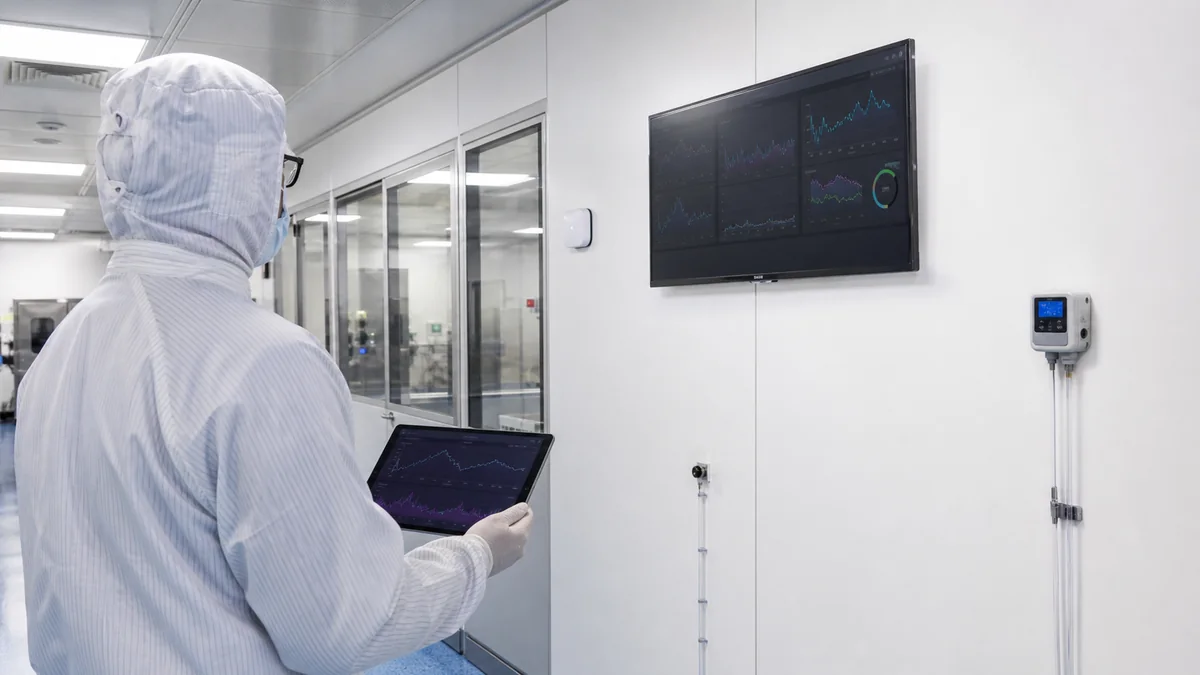
Choose monitoring locations from the process and contamination risks. A convenient wall position may miss an exposed operation, while a sensor directly in a supply jet may not represent the occupied room. For pressure, document both measurement points, the sign convention and the reference location so a positive value has an unambiguous meaning.
Remote particle sampling also depends on transport to the instrument. Tubing length, bends, diameter, material and flow can affect how many particles reach the detector. Keep the route appropriate to the instrument and justify the installed arrangement; do not assume a long tube is equivalent to sampling directly at the point of interest. Changing the tube route can change the measurement even when the room is unchanged.
Design alarms around actions, not just colored displays
Define who responds to each alert or action condition and what information they need. A warning trend, a sustained process-limit exceedance and an instrument fault should not look identical. Alarm delays may distinguish a brief, understood door event from a persistent loss of pressure, but must be justified rather than adjusted simply to suppress frequent alarms.
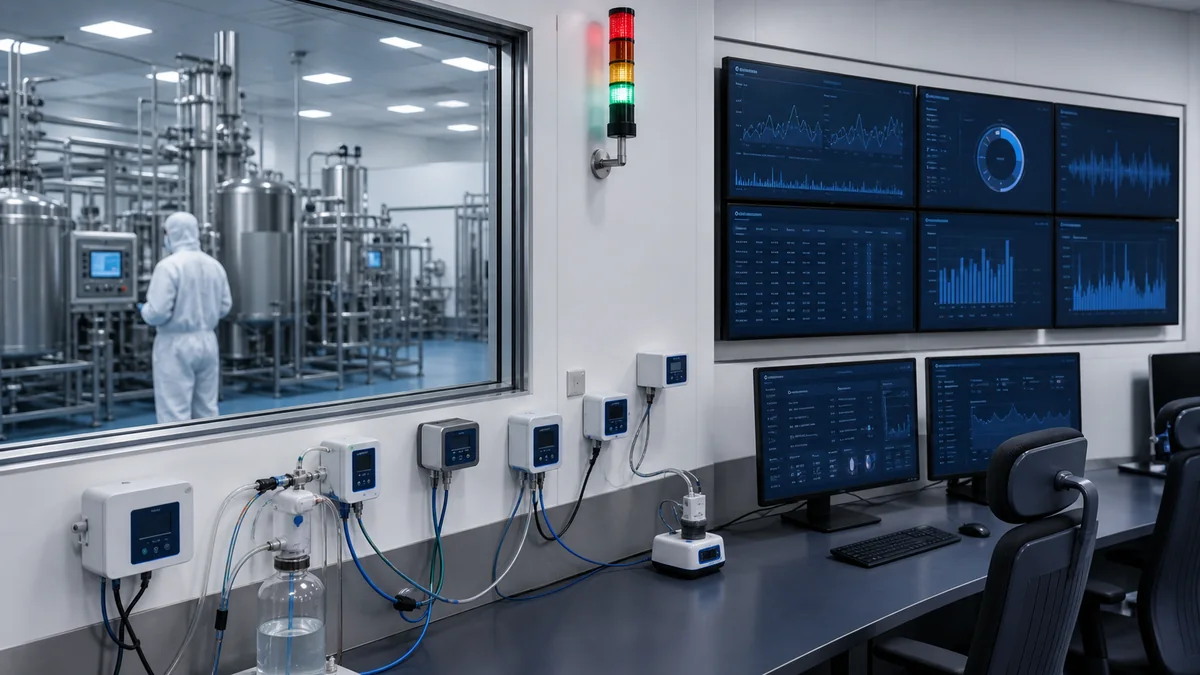
Record invalid samples, low-flow faults, communication loss and missing data explicitly. An empty period is not a zero reading and a last-known value is not a fresh measurement. Consistent clocks, access controls and retained configuration changes make it possible to compare an event with door activity, maintenance or a production step.
Investigate a pattern without mistaking it for proof
A pressure dip aligned with a door-open record suggests a different investigation from a pressure loss that persists after closure. A particle increase during a new handling step may direct attention to that activity, but it does not automatically exclude a filter or airflow problem. Check the instrument's status and calibration before interpreting a surprising trend, then compare other relevant measurements and operating records.
At commissioning, verify the measurement chain, displayed units, timestamps, alarm delivery and recovery after a defined interruption. Test these functions through approved simulation or instrument procedures rather than deliberately contaminating a working area. Keep a point schedule that identifies each sensor, range, location, calibration requirement, alarm purpose and record owner.
Plan control and environmental monitoring devices, microbiological monitoring products and testing instruments according to their separate jobs. Together they can support a stronger investigation than a dashboard of unexplained numbers.