


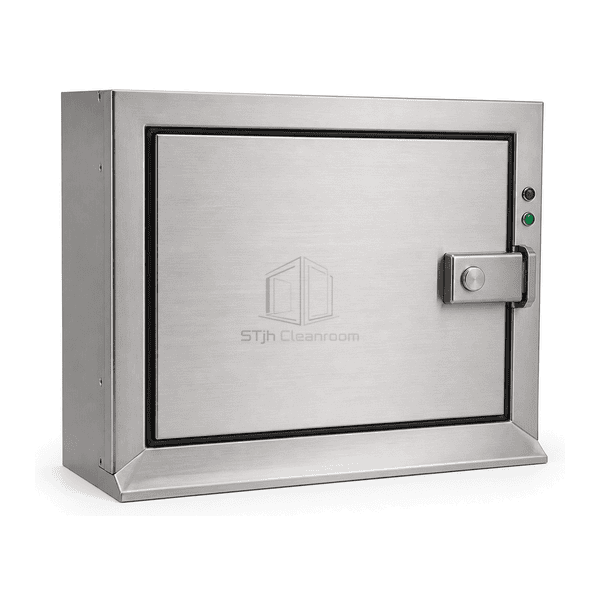
A pass through chamber is a dedicated opening for moving materials between adjacent spaces without using the personnel door for every transfer. Its success depends on three interfaces working together: the load must fit through the clear opening, the body must fit and seal into the wall, and the doors must support the intended transfer sequence.
Internal chamber dimensions alone do not settle any of those three interfaces. A package can fit inside yet catch on the doorway. A chamber can fit the wall cut-out but project into a working aisle. An interlock can control the doors while leaving a poorly finished gap around the installed body.
First decide whether the chamber transfers or treats the load
A passive chamber provides a controlled route but does not actively filter the chamber air or sterilize its contents. A filtered chamber adds an airflow system. A decontamination chamber adds a defined treatment process and its associated controls. Select the required function from the receiving process rather than adding treatment terminology to a basic hatch.
This article addresses the dimensional and installation decisions for material-transfer chambers, with particular attention to compact passive hatches. It is not a basis for substituting a passive hatch for a validated sterile transfer process. FDA's aseptic processing guidance highlights the need to control material movement from less clean to more clean areas. That is a process-design responsibility extending beyond the cabinet itself.
Use five dimensions instead of one nominal size
| Dimension | What it describes | Why it matters |
|---|---|---|
| Complete load envelope | The pack, tray, handles, protective wrapping and handling space | Prevents specifying a chamber around the bare item only |
| Clear doorway | Unobstructed opening past frame, hinges, latch and seals | Determines whether the complete load can enter without contact |
| Usable interior | Space remaining with both doors closed and any tray fitted | Determines stable placement and access from the receiving side |
| Wall cut-out and body | Installation opening, overall body and flange coverage | Coordinates the chamber with the partition and support detail |
| Projection and service envelope | Door swing, handle projection and maintenance access on each side | Keeps the installation usable after neighboring equipment is installed |
Measure the load in the condition in which it actually crosses the boundary. Include the tray and packaging layers that remain at that stage. A loose label flap or handle can be the part that contacts the door frame, even when the product itself fits comfortably.
Check how the receiving operator retrieves the load. A deeper chamber can make a small pack difficult to reach. Do not solve a reach problem by routinely placing the pack against the receiving door: that can interfere with sealing and change the way the door opens.
Resolve the wall section before cutting the opening
Show the partition thickness, finished faces, body position, support method and flange on a coordinated section drawing. Identify which side is flush and which side projects. Include wall coverings or finishes that affect the final thickness.
The installation must support the chamber and its intended load through an appropriate structure. Decorative trim is not a substitute for the required support arrangement. For lightweight partitions, coordinate reinforcement and attachment details with the wall supplier before fabrication.
Define the perimeter finish on both sides. The detail should close the installation gap and remain accessible for cleaning and inspection. Specify the sealant and surface preparation for the actual adjoining materials and cleaning chemicals. Do not conceal an unfinished void behind a trim plate and assume the wall interface is complete.
Keep door control separate from air leakage
An interlock manages the permitted opening sequence. It does not demonstrate the tightness of a closed door, the integrity of the wall perimeter or the pressure relationship between rooms. Review these functions separately in the specification and acceptance plan.
Describe normal operation, an incompletely closed door, loss of power where relevant, and the authorized recovery method. State how staff see that the opposite door is open or unavailable. If a delay is needed, define the process reason and release condition instead of inserting an arbitrary countdown.
A room-pressure difference also belongs in the design review. Provide the normal operating relationship and any relevant abnormal conditions to the supplier. Do not assume the hatch can tolerate every differential pressure simply because it has opposing doors.
Inspect the transfer surface as a maintained component
The transfer surface must support the actual load without obstructing closure. If a removable tray is used, confirm its removal direction and where it is cleaned and stored. Check the underside and supporting ledges, not only the visible top.
Agree the cleaning method for the liner, door seals, handles and tray. Keep the chemical compatibility question specific to the supplied assembly. Cleaning access that requires opening both doors at once conflicts with a normal interlocked sequence; plan the approved maintenance condition separately from routine transfer.
Make it clear whether the chamber is a transfer point or a storage location. Accumulated packs can block the next transfer, obstruct inspection and make the chamber's status unclear. Where temporary holding is part of the process, define the permitted contents and duration in the operating procedure.
Check the installed chamber before routine use
Match the drawing: verify body position, finished wall interfaces, support, door swing and service access.
Check closure: inspect seals and hardware, remove transport materials and verify unobstructed closure from both sides.
Exercise the controls: check the intended interlock sequence and the agreed abnormal-condition response without forcing a locked door.
Try the representative load: move the actual tray or package through the clear opening and retrieve it using the normal hand position.
Complete the cleaning review: demonstrate access to the liner, tray underside and perimeter surfaces.
Record process acceptance: complete the checks specified for the receiving area's transfer process before routine operation.
Keep dimensional checks separate from any process testing that the installation requires. Passing a fit check does not establish decontamination effectiveness, and a functioning interlock does not establish room cleanliness.
Use the compact zhengfeng hatch for the right transfer duty
The zhengfeng compact cleanroom transfer hatch is described for hand transfer of small packs and documents, with opposing doors and a removable tray. Its product page distinguishes selectable interior dimensions from the wall cut-out and overall body. Use that distinction when reviewing the drawing rather than ordering by a single nominal size.
For a quotation, send the complete load dimensions and weight, transfer direction, room relationship, wall section, desired mounting height, available door-swing space and cleaning method. Add the required control arrangement and any treatment function as separate requirements. If the load needs a trolley or a treatment cycle, explain that at the start so the configuration can be assessed against the actual duty.
Frequently asked questions
Is a pass through chamber the same as a pass box?
The terms are often used for similar transfer equipment. The specification matters more than the label: state whether the unit is passive, filtered or designed around a treatment process.
Can the wall opening be cut from the internal chamber size?
No. The installation opening must come from the approved overall drawing, including body, support, flange and finishing details.
Does an interlock replace cleaning the package?
No. Door sequencing does not remove contamination from a package. Prepare transferred materials according to the receiving area's established procedure.