


Clean room carts should be selected around the transfer they must complete, not just the number of shelves they carry. A suitable cart keeps the load stable, fits the entire route, exposes its surfaces for cleaning and provides the required protection while moving. A stainless frame alone does not answer those questions.
Start with one defined journey: from the loading point, through every doorway and turn, to the receiving workstation. Then check the load, route and cleaning method together. This approach helps avoid buying a trolley that fits the room but cannot perform the actual transfer reliably.
Choose the cart format around how materials are handled
Open shelf carts work well when packaged tools and components need frequent access within a controlled area. A tray rack is useful when separate batches must remain on individual carriers. Neither arrangement creates a protected environment around exposed parts during travel. Where the transfer crosses a less controlled space, assess packaging, an enclosed cart or a suitably designed filtered transport system against the material's requirements.
| Transfer task | Useful configuration | Detail to resolve |
|---|---|---|
| Packaged supplies between workstations | Open solid-shelf trolley | Usable shelf area, load retention and access for wiping |
| Small assemblies kept in separate batches | Removable-tray cart | Tray support, clear height, identification and transport restraint |
| Tools that need organized access | Compartmented or drawer arrangement | Cleanability of runners and stability with a drawer open |
| Exposed sensitive materials crossing zones | Packaging or protected transport selected for the process | Protection during loading, travel and unloading |
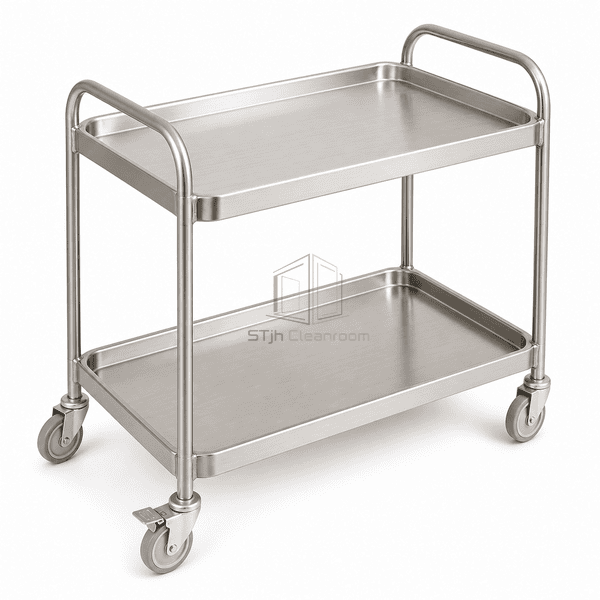
zhengfeng's Cleanroom Material Trolley provides two open stainless shelves, raised edges and a rounded push frame. Its listed options include different shelf arrangements, 304 or 316L stainless steel, solid or perforated shelves and alternative caster configurations. Choose these options for a defined task rather than assuming every option is needed.
Measure the loaded envelope, including the operator
The critical dimensions are not limited to the shelf length and width. Record the overall cart dimensions, handle projection, caster swing, highest loaded point and any containers extending beyond the frame. Use the narrowest door opening and tightest turn on the actual route as design inputs. A cart may pass straight through a doorway but still be difficult to turn into it from a narrow corridor.
Check where the operator stands to push, apply the brakes and remove the load. Include door swing, airlock occupancy and the space required for a receiving table. For tray handling, the removal direction matters: a clear aisle alongside the cart does not help when trays must be pulled from its front.
Specify shelf load and total payload separately
Ask for both the permitted load per shelf or tray and the total cart payload, with the assumed distribution stated. A frame rating is not automatically the rating of a removable plastic tray. Adding shelf levels also does not increase the capacity of the frame, joints or casters.
Define whether the contents produce a distributed load or small concentrated contact points. Keep heavy items low where practical and avoid layouts that become top-heavy as lower trays are removed. Raised shelf rims can help retain packages, but tall vessels and unstable equipment may need a different restraint. During acceptance, check loading, starting, turning, stopping and unloading with representative contents under agreed conditions.
Treat trays and their supports as a matched assembly
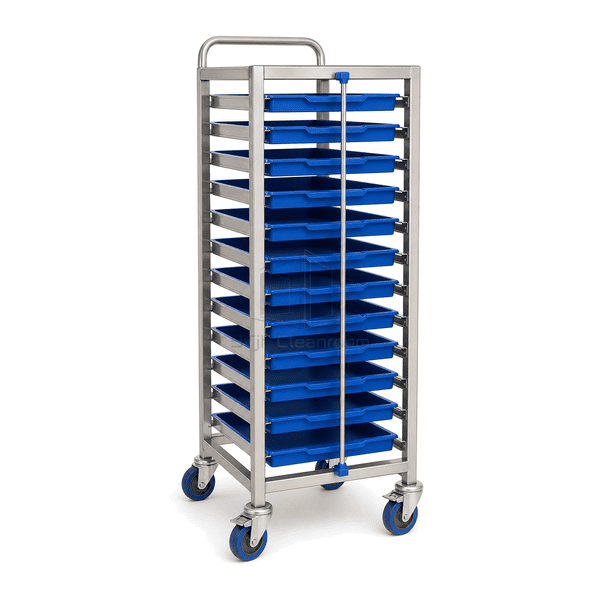
A tray cart can reduce repeated stacking and unstacking, but only when the tray and runner geometry work together. zhengfeng's Cleanroom Tray Cart has twelve removable polypropylene trays on dedicated runners, with rear stops and a front retaining bar. The stops establish insertion depth; the front bar restrains movement in the opposite direction during transport.
Check tray rim support, runner spacing and the clearance above the loaded tray. A replacement tray with similar outside dimensions may still sit incorrectly or fail to engage its restraint. Do not use a partly withdrawn tray as a work surface unless that position is specifically supported and load-rated. Park the cart before removing a shared retaining bar, and keep a receiving surface available.
Look beyond the wheel's non-marking description
Non-marking describes visible floor scuffing; it does not establish low particle release, chemical resistance or electrical conductivity. Select the wheel compound, bearing construction and brake arrangement for the floor, payload, cleaning chemistry and route. Check replacement access as well as initial running performance.
Clarify whether a brake stops wheel rotation only or also locks the swivel. Operators must be able to reach it without putting hands beneath the loaded cart. For an ESD-sensitive process, define the required electrical behavior of the complete load-to-floor path. A conductive caster alone does not establish that the load, shelf interface and flooring form a suitable system.
Make cleaning access part of the daily workflow
Review shelf undersides, handles, welded intersections, caster forks, wheels and removable tray supports. These areas can be missed when the cleaning method only addresses visible upper surfaces. Verify that cleaning agents and any wash temperature suit the entire assembly, including polymers and bearings, rather than only the stainless shelves.
Define how a cart moves between controlled areas: whether it remains dedicated to one zone, is cleaned at a transfer boundary, or transfers its packaged contents to another cart. Keep clean and used materials clearly separated. Set inspection and maintenance intervals from actual use and the component supplier's instructions, with extra checks after impact, damaged wheels or a change in cleaning chemistry.
Compare Shelf, Wheel and Restraint Choices Together
| Choice | Useful feature | Trade-off to resolve |
|---|---|---|
| Solid shelf with raised rim | Supports small packages and helps retain them at the edge. | The rim can obstruct sliding a load onto a receiving surface; shelf corners and the underside still need cleaning access. |
| Open or perforated shelf | Provides openings through the shelf surface. | Small items, package feet or soft bags need suitable support. Open area alone does not prove that the cart preserves a required airflow pattern. |
| All-swivel caster arrangement | Allows repositioning in several directions. | Straight tracking and starting behavior differ from an arrangement with directionally constrained wheels. |
| Fixed and swivel caster arrangement | Provides a defined steering direction. | The turn needs more planned space; check the route with the selected handle position and travel direction. |
| Wheel brake versus total lock | A wheel brake prevents rolling; a total-lock design can also restrain swivel movement. | Confirm the actual mechanism and accessible control position. A brake is not a substitute for a level, suitable parking location. |
| Removable trays and shared retainer | Keeps batches separated and allows tray exchange. | Opening a shared retainer affects multiple trays. Park securely and control the load before release. |
Match the options to the material trolley or tray-cart drawing rather than assuming every listed choice can be combined. Include the handle, wheel and load-retention details in the approved configuration. A replacement caster with a different installed height changes shelf level and support; a matching wheel diameter alone does not establish interchangeability.
Assess Stability in the Least Favorable Normal Loading State
Stability changes as trays or containers are removed. A full cart with heavy material on its lower shelves can become less stable when the lower load is delivered and an upper load remains. A tray or drawer pulled outward also moves weight away from the center of the support footprint. Plan the delivery order and access arrangement rather than testing only a fully loaded stationary cart.
Turning, stopping and crossing a threshold add forces that a static shelf rating does not describe. Keep the intended load within its support and restraint arrangement, and assess the route using representative containers under a controlled procedure. Do not assume that multiplying a caster rating by the number of casters produces a permitted cart payload: frame strength, mounting, load distribution and uneven floor contact also constrain the assembly.
Use the Transfer Problem to Choose the Correction
| Observed problem | Likely interface to examine | Selection or layout response |
|---|---|---|
| Cart fits the doorway but cannot turn into it | Loaded swept path, handle projection and the operator's position. | Review frame length, steering arrangement, approach direction or staging location. |
| Tray moves when the cart stops | Runner engagement, rear stop and front restraint. | Restore compatible support and restraint; do not use shelf friction as the transport lock. |
| Push effort rises after cleaning or impact | Wheel tread, bearings, swivel action, trapped debris and alignment. | Inspect and service the affected components before replacing the whole cart or loading it more heavily. |
| Unloading exposes materials to a lower-control area | Protection during the receiving step, not only during travel. | Replan packaging, transfer boundary or receiving arrangement for the complete journey. |
Record the accepted load pattern and the most restrictive door, turn or transfer point with the cart specification. This turns a quotation for a generic trolley into a repeatable material-handling configuration and gives zhengfeng the information needed to discuss the relevant cart and accessory options.
Use an acceptance check that follows the real transfer
Load representative contents and confirm identification, distribution and retention.
Walk the agreed route, including thresholds, turns and doorways.
Check steering, starting effort, brake access and parked stability.
Remove and replace trays or containers without unintended contact or unsupported loads.
Perform the intended cleaning sequence and inspect difficult-to-reach areas.
Record the approved configuration, replacement parts and operating limits.
Frequently asked questions
Are solid shelves always better than wire shelves?
No. Solid surfaces support small items and are straightforward to wipe, while open shelving can allow more air passage. The load, cleaning method and surrounding airflow determine which trade-offs matter. The shelf format alone does not establish cleanroom suitability.
Can an open cart move unpackaged parts between clean zones?
Only where the process assessment and transfer procedure permit that exposure. An open cart does not preserve a separate clean environment around its load. Consider the entire route, not just the conditions at its start and finish.
What should I send with a quotation request?
Send the load dimensions and weight, shelf or tray arrangement, narrowest access points, cleaning method and any ESD requirements. Include covers, restraints, spare trays and replacement casters in the scope.
Build the cart around your material flow
Explore zhengfeng's cleanroom carts and material-handling range to compare open trolleys, tray-based transport and other handling formats. For packaged supplies, start with the material trolley; for separated small batches, review the tray cart and its support interfaces. Send your transfer requirements so the quotation addresses the route, payload, cleaning and accessories together.
Further technical reading: SPS CleanTech's cart configuration overview describes material, caster and surface alternatives. zhengfeng product links above provide the specific configurations discussed here.