


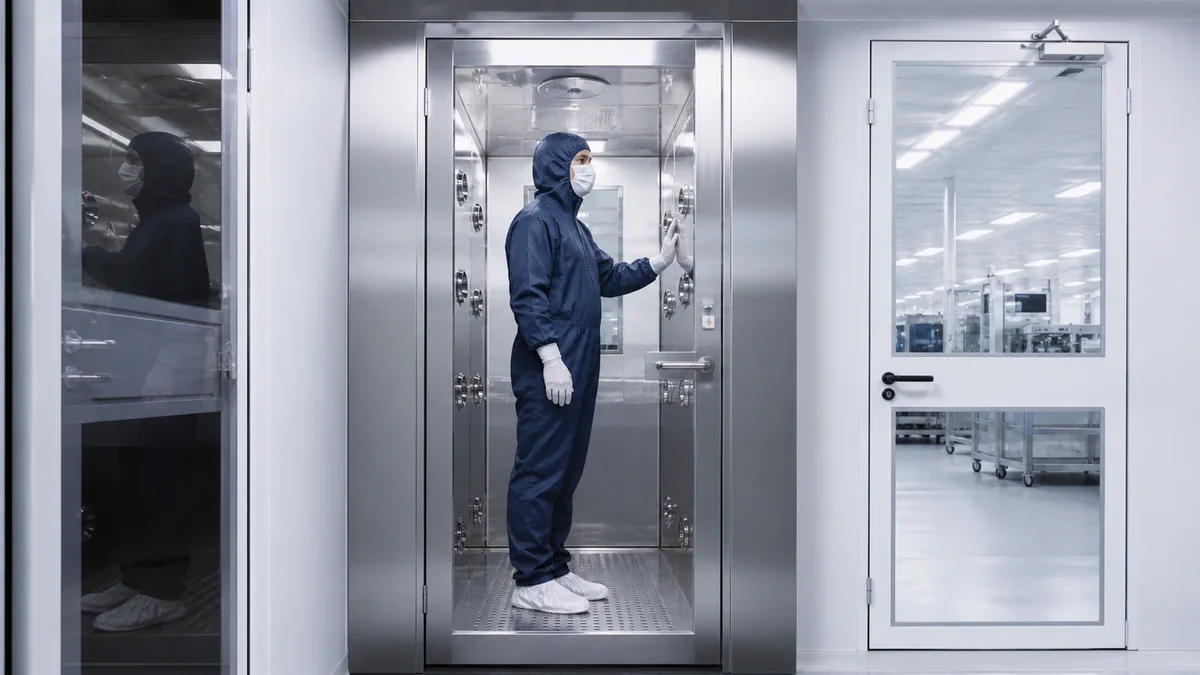
A cleanroom air shower is a particle-removal stage in the personnel entry route. Filtered jets can dislodge loosely attached particles from the outside of correctly worn garments before the wearer enters the cleaner area. Its benefit depends on the complete sequence: gowning, chamber loading, airflow, door operation and the way people move after leaving it. An air shower does not make an unsuitable garment clean or replace the room's contamination-control procedures.
Follow the particles, not just the air jets
In a recirculating air shower, nozzles direct filtered air towards the garment. Displaced particles enter the chamber air, which is drawn towards return grilles and passes through the filtration system before recirculating. Prefilters protect the downstream high-efficiency filter from larger debris. Removal therefore depends on both the jet pattern and an unobstructed return path; a strong jet alone does not demonstrate that contamination is being collected effectively.
This is physical particle removal, not a validated disinfection or sterilization process. It does not reliably clean concealed surfaces or remove every particle held by fabric, moisture or static attraction. A conventional recirculating entry shower must not be assumed suitable for removing hazardous dust, chemicals or biological contamination from workers; that is a separate containment and occupational-safety application.
Capacity means usable space and a workable cycle
The chamber must allow the intended number of users to stand and follow the operating procedure without shielding one another from the nozzles. Garments, carried objects and carts can obstruct jets or returns. A nominal person count is not a substitute for checking the clear internal space and door openings against actual use. For example, a single-person cleanroom air shower should be assessed around one user's gowning routine and movement, not treated as a small cargo tunnel.
Cycle duration also affects traffic. Loading, door closure, the air cycle and unloading all occupy time. Selecting a chamber only from the jet-on time can create queues at shift changes. Repeatedly shortening or bypassing the cycle to clear those queues defeats the intended entry procedure. Establish a cycle using the equipment instructions and a site assessment, rather than borrowing a time from another installation.
Interlocks control access; they do not balance room pressure
Door interlocks help prevent an open route between the two adjoining areas during normal use. They do not independently establish a pressure cascade or compensate for poorly closing doors. Confirm door handing, closing clearance, normal entry and exit logic, power-failure behavior and emergency release as part of the entrance design. Emergency egress must remain consistent with applicable safety requirements; operators should never have to defeat an interlock to leave safely.

What to verify at handover and during use
- Air delivery: record nozzle measurements using the agreed method and compare like-for-like positions and settings during later checks. Investigate a decline against the accepted baseline.
- Access sequence: check door sensors, closure, cycle initiation, release and the specified emergency functions. A cycle timer running on the display does not prove correct door operation.
- Cleanability and service: keep returns clear, inspect seals and clean the chamber under the site procedure. Ensure filter and fan access remains usable after surrounding walls and services are installed.
- Entry effectiveness: assess the actual gowning and traffic routine with suitable contamination data. Nozzle velocity alone cannot establish a universal particle-removal percentage or the cleanliness of the receiving room.
If airflow declines, review prefilter condition, return obstructions, fan operation and filter resistance before assuming one cause. Electrical and internal servicing should be performed by qualified personnel with the unit safely isolated. A maintenance plan should follow the supplied equipment instructions and operating conditions, not a generic calendar replacement rule.
Compare the available personnel and material transfer equipment once the entry route, usable chamber size, peak traffic and service clearances are defined.