


A boot washer can remove soil from footwear yet still leave a hygiene problem immediately beyond the machine. Dirty rinse water, overloaded brushes or an uncontrolled exit route can carry material back onto the floor. The right assessment follows the complete journey: incoming boot, brush contact, wastewater collection and the first steps after washing.
This matters at wet-processing entrances, food-production hygiene barriers and other workplaces that use washable footwear. It is not a reason to put a wet washer at every cleanroom entrance. Where moisture must be excluded, the footwear method and its location need a different arrangement. Choose the process around the soil and the area, then select the machine.
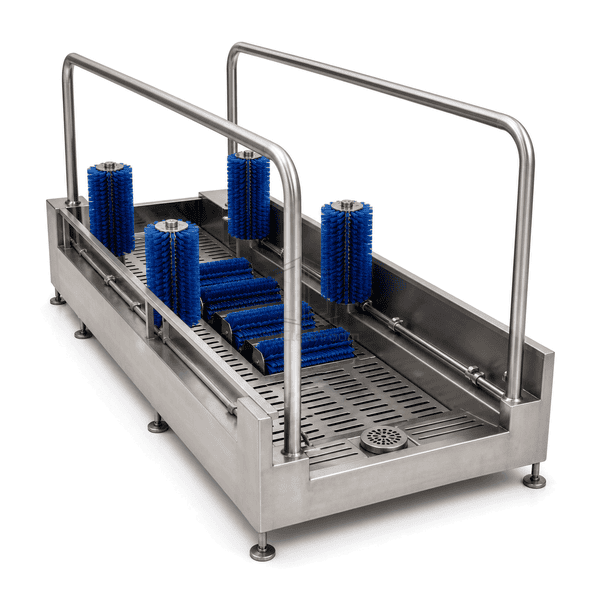
Identify the soil before selecting the brush arrangement
Dry powder, sticky food residue and coarse outdoor dirt do not behave alike. State what accumulates in the tread and whether the boot shaft also needs cleaning. Examine representative worn footwear, not only a new boot with an empty sole. Deep tread recesses and damaged surfaces can retain material that a quick pass fails to reach.
| Operating condition | Selection question | Evidence to check during a trial |
|---|---|---|
| Soil concentrated in the sole tread | Does the sole brush contact the relevant tread areas? | Compare the same recesses before and after the approved pass |
| Contamination on boot sides or shafts | Are side brushes needed, and do they suit the boot height? | Check coverage without forcing an awkward stance |
| High soil loading at shift entry | Can the collection and drain arrangement handle the solids? | Inspect the basket and wastewater path after a representative entry period |
| Moisture-sensitive area beyond the barrier | Where will carryover be controlled before entering that area? | Observe the actual exit floor and footwear route |
Brush contact is a mechanical cleaning step. Chemical treatment is another part of the process. Neither the presence of a dosing pump nor a visibly wet boot proves that a specified sanitizing result has been achieved. Footwear hygiene programs combine equipment and chemistry around the operating conditions; the chosen chemical's instructions remain essential.
Keep the dirty and clean sides physically understandable
Draw the route before ordering: waiting position, machine entry, working section, exit and the next required hygiene step. Include people moving in the opposite direction, doors opening into the area and carts passing nearby. If a person has to step back onto the incoming floor after washing, the route defeats part of its purpose.
Do not rely on a turnstile alone to define hygiene. It controls movement, while brushes, water, chemistry and the operator's actions determine what happens during passage. State what condition permits the gate to open and how faults are shown. A completed sensor event is not a direct measurement of cleanliness.
Place the washer where its wet operation is supported by the building. The floor, drain, service connections and cleaning access must work together. OSHA's walking-working surface requirements address drainage and safe standing conditions for wet processes. Do not allow normal washer operation to create an uncontrolled slip hazard at the exit.
Diagnose water carryover in a useful order
A wet exit does not always mean the spray setting is too high. Reducing water without checking the cause can leave the brush section poorly flushed. Work through the route in order and record where water first escapes the intended collection area.
Check the drain and solids basket. An obstructed outlet can raise the collection level and cause splash or overflow. Follow the safe cleaning procedure before removing trapped material.
Inspect spray distribution and guards. Look for displaced nozzles, damaged splash panels or water directed outside the working section.
Observe a normal passage. Confirm the user follows the intended path and does not step onto unintended edges. Compare the largest and smallest footwear used at the site.
Check chemical preparation. Excess foam can change how the collection system behaves. Use only the specified compatible chemistry and concentration, not an arbitrary stronger mixture.
Review the exit arrangement. The transition must suit the destination's moisture tolerance and be maintainable during peak use, not only when the machine is idle.
After correcting the cause, repeat the same operating condition and inspect the same floor locations. Repeatedly mopping the exit without recording when water returns makes it difficult to distinguish a drainage fault from ordinary carryover.
Measure shift capacity as a complete entry process
Purchasing decisions often compare nominal people per minute, but the queue is governed by the slowest required step. Include approaching the machine, using the handrail, effective brush contact, exit movement and any connected hand-hygiene or access-control action.
Record the peak arrival pattern, not only total staff per shift. A ten-minute surge and a steady arrival stream create different space requirements. Observe whether workers shorten contact or bypass the machine when the queue grows. If the process is too slow, review the entire entry arrangement rather than simply shortening a treatment step that has not been evaluated at the new setting.
A useful capacity trial records the number of completed passages, queue length, interruptions and the condition of brushes, water and exit floor at the end. It should also show where a person waits while the preceding user completes the sequence. This produces a realistic operating plan instead of a headline throughput number with no conditions attached.
Use a start-of-shift and end-of-shift routine
Before the first entry
Confirm that guards and removable parts are fitted, handrails are secure and the approach is clear. Inspect brushes for trapped debris, unusual wear or damaged elements. Check the collection system, water availability, chemical supply where fitted and the correct operating direction. Carry out the manufacturer's approved control and safety checks before normal use.
During operation
Watch for accumulating soil, loss of spray, unusual noise, blocked drainage and changes in exit-floor condition. Set inspection frequency around actual loading and the hygiene plan; a fixed calendar interval alone may miss a heavily used entry period. Stop the process when a fault prevents the required cleaning sequence rather than allowing uncontrolled bypass.
After the entry period
Remove collected solids and clean accessible components under the supplied procedure. Clean the machine itself without carrying dirty wash water into the receiving area. Brush removal, unjamming and work near moving parts require appropriate isolation by trained personnel. OSHA's hazardous-energy standard covers servicing where unexpected startup or stored energy can injure workers; a normal stop command is not the same as verified energy isolation.
Use faults to decide what to maintain
| Observed problem | Checks before changing settings | Return-to-service check |
|---|---|---|
| Tread remains visibly dirty | Brush contact and condition, passage method, soil loading and water distribution | Repeat the approved trial using representative footwear and soil |
| Water accumulates around the unit | Drain restriction, collection level, spray direction and leaks | Run under normal use and confirm the surrounding route remains controlled |
| Excess foam reaches the exit | Chemical suitability, dilution and introduction point | Verify correct preparation and stable operation |
| Entry stops intermittently | Recorded alarm, sensor condition, guard position and supply status | Complete the normal sequence and the specified fault checks without bypassing protections |
Send a quotation brief that includes the building interfaces
For an zhengfeng automatic walk-through boot washer, provide footwear sizes and heights, soil type, peak arrivals, direction of travel and the available installation footprint. Include the water supply, drainage position, electrical voltage and frequency, and the planned cleaning chemistry. Identify who provides the surrounding floor work, plumbing and final site connections.
Ask the quotation to distinguish sole-only cleaning from sole-and-shaft coverage, explain brush access and list replacement items. Specify the intended control sequence and the observations required during handover. A clear scope helps compare machines on operating suitability and maintenance, not only purchase price.
Common questions
Can a boot washer replace a footwear-change procedure?
Only if the site's hygiene assessment supports that route. Washing footwear and changing into dedicated footwear address different transfer patterns. Choose the method for the destination and contamination risk.
Does visible cleanliness prove sanitizing performance?
No. Soil removal and microbial performance are different results. Chemistry, contact conditions and the site's verification method determine the latter; do not infer it from brush action alone.
What should be reviewed after adding a second shift?
Recheck peak queues, solids accumulation, chemical use, cleaning frequency and the exit floor. Greater use can expose a drainage or maintenance limitation even when the individual passage has not changed.
Use the inquiry form on the boot-washer product page to send zhengfeng the route, footwear and utility details. These inputs support a configuration that fits the entry process and can be maintained after installation.