


Stainless steel cleanroom furniture is selected for more than its appearance. The useful combination is a suitable alloy, a well-finished construction, practical cleaning access and a layout that supports the work. A stainless surface does not make a table sterile, prove that every component is low-shedding, or guarantee compatibility with every cleaning chemical.
Choose the material for the exposure, not the label alone
Type 304 and 316-family stainless steels are common options, but the choice should follow the operating environment. The molybdenum in 316/316L improves resistance to some forms of localized corrosion compared with 304; it does not make the surface immune to chlorides or aggressive cleaning conditions. Consider the cleaner or disinfectant, concentration, contact time, temperature and whether residues are removed according to the approved cleaning procedure.
Material grade and surface condition are separate questions. Poorly finished welds, embedded contamination or damage can create local problems even when the alloy is appropriate. Ask for the specified material and finish on the drawing or order rather than relying on a photograph or an informal description such as medical-grade stainless steel.

Inspect the places a cleaning wipe cannot easily reach
Look under the worktop, around shelf brackets, inside drawer runners and at the junction between legs and frames. Unsealed hollow sections, rough welds and closely spaced overlapping parts can be harder to clean than the main work surface. Smooth accessible joints, suitable closure of hollow sections and finished edges are useful design features when they match the cleaning method.
More storage is not always better. An undershelf creates useful space but can restrict floor cleaning or access to the underside of the bench. Drawers protect organized tools but introduce runners and internal surfaces that need a cleaning plan. Specify only the storage needed for the task and leave access around the furniture.
Solid and perforated tops have different jobs
A solid top supports small components and can contain a work tray or minor spills more predictably. It may, however, obstruct downward airflow when placed in a critical clean-air zone. A perforated or open surface can reduce that obstruction in a suitable layout, but holes can trap small parts, allow liquids through and increase the surfaces that must be cleaned.
Neither top style establishes a cleanliness class. Assess the loaded work area and the airflow around it where product protection is critical. Compare a stainless steel workbench against the tools, parts and cleaning routine it will actually support, not only the available floor space.
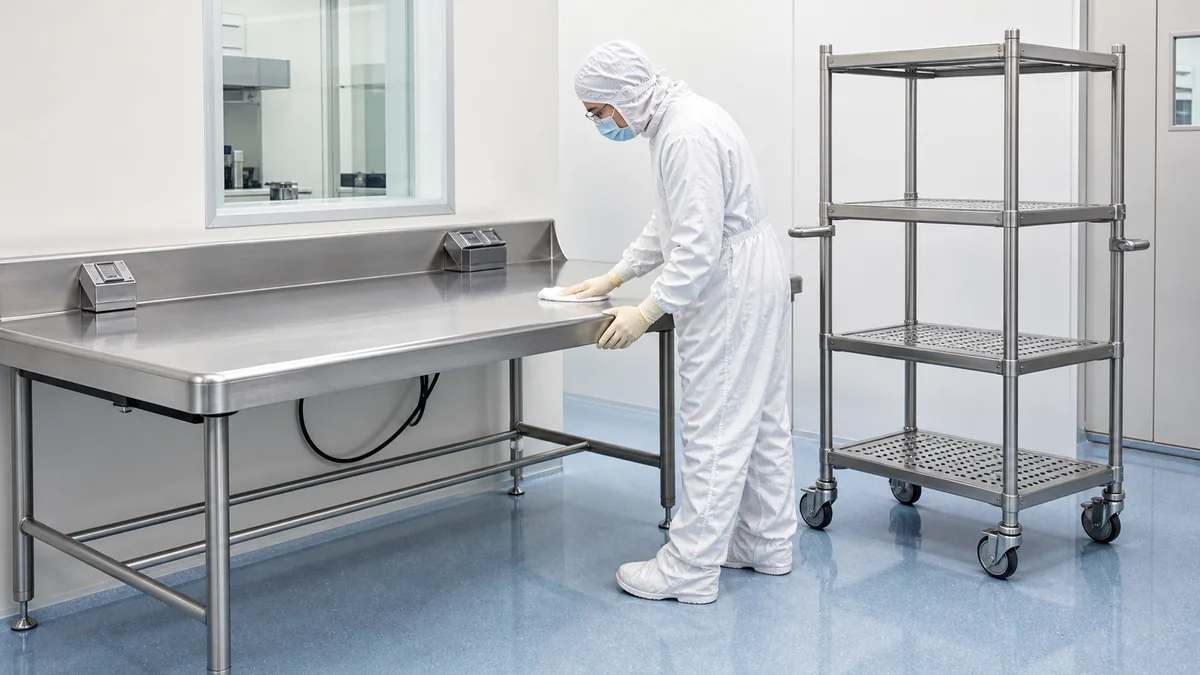
Check the route as carefully as the workstation
Mobile furniture must pass through the actual clear door opening, turn in the available corridor and cross floor transitions safely. Include handles, bumpers and the load itself when checking dimensions. Wheel materials, bearings and brakes must suit the floor and cleaning exposure. Where ESD control is required, a stainless frame alone does not establish a verified path to ground through the wheels and floor.
State whether the load is evenly distributed, concentrated at one point, placed on one shelf or moved on a cart. These are different conditions. A shelf rating should not be treated as the total mobile-unit rating, and a cart should not be loaded above its confirmed capacity or used with an unstable load arrangement. Fixed benches need stable leveling; mobile units need effective restraint during the intended stationary operation.
Use a task-based furniture schedule
For each item, record the task, usable work height, overall and clear dimensions, load arrangement, material, finish, storage, mobility and cleaning exposure. At receipt, check accessible welds and edges, stability, hardware, caster operation and the agreed dimensions before introducing it into the room. Remove transport residues using the approved method and avoid cleaning tools that damage or contaminate the surface.
Review cleanroom furniture together with material handling and storage. The aim is to keep incoming materials, active work and completed items organized without obstructing cleaning, returns or personnel routes.