 Inglês
 Alemão
 Língua árabe
 Francês
 Língua indonésia
 Japonês
 Coreano
 Língua malaia
 Portuguêsatual
 Língua russa
 Espanhol
 Tailandês
 Língua turca
 Vietnã
Hidden connection
The bonding material sits in the joint cavity, leaving the exposed stainless surface free from screw heads and fixing holes.



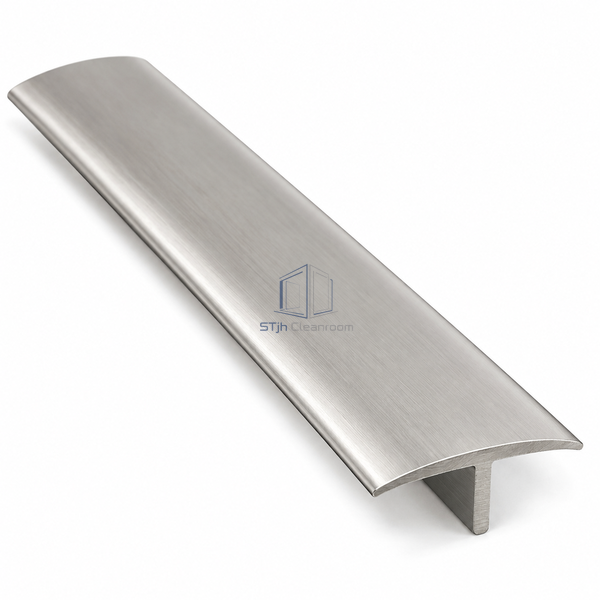
This stainless transition profile is held within the existing joint cavity rather than fixed through its upper face. The 9 mm vertical leg is pressed into a compatible adhesive, and the lateral top covers the edges of the two adjoining finishes. The arrangement is intended for equal floor heights, distinguishing it from a rounded surface strip used to bridge a small step.
The bonding material sits in the joint cavity, leaving the exposed stainless surface free from screw heads and fixing holes.
The top bears over both neighboring finishes to shield their meeting edges from direct mechanical contact.
The symmetric T form provides an orderly junction when both floor surfaces finish at the same elevation.
| Material | AISI 304 stainless steel |
|---|---|
| Section | T-shaped inlay |
| Visible Width Options | 14 or 25 mm |
| Vertical Leg Height | 9 mm |
| Minimum Joint Depth | 9 mm |
| Standard Length | 2500 mm |
| Attachment | Compatible adhesive within joint cavity |
| Floor Levels | Equal height |
| Finish Options | Natural or brushed stainless |
| Customização | Disponível com base na aplicação pretendida e no ambiente operacional. |
Consider for equal-level tile, stone and compatible rigid-floor transitions in healthcare corridors and clean support interiors. Remove debris from the cavity before installation and make sure the joint has enough depth for the leg. This cover trim should not replace a designed structural movement joint.
Use the concealed vertical leg and an appropriate bonding material inside the existing joint.
Clean and measure the cavity before bonding so that the leg can seat to its full depth.
Select face width, finish and cut length according to the joint opening. Check the neighboring materials and adhesive compatibility so that both the anchorage and edge overlap remain suitable for the floor.
Envie-nos as suas dimensões, condições de instalação, metas de desempenho e acabamento de superfície necessário.