 Anglais
 Allemand
 Arabe
Arabe FrançaisCurrent
 Indonésien
 Japonais
 Coréen
 Le malais
 Le portugais
 russe
russe espagnol
 Thaïlandais
 Le turc
 Le vietnamien
Longest classified route
The 136 in chamber provides the greatest active travel and holding distance in this hazardous-location series.



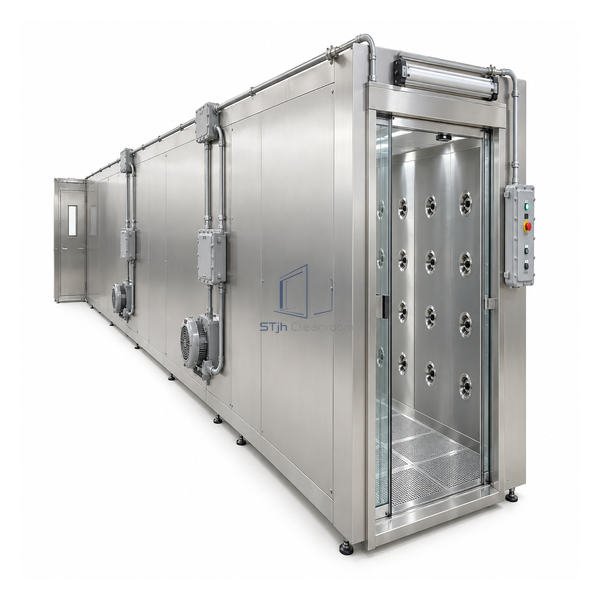
At 144 in overall depth, this is the longest accepted explosion-resistant configuration. The 136 in internal path and three blower sections support approximately four occupants or a longer staged passage. Stainless construction, pneumatic access and the cited Class I, Division 2 basis distinguish it from general cleanroom tunnels; the Group C and D lighting basis must still be reconciled with the actual site classification.
The 136 in chamber provides the greatest active travel and holding distance in this hazardous-location series.
Separate blower zones distribute filtered jet coverage along the extended tunnel.
Approximate four-person occupancy reduces the number of cycles needed during coordinated entries.
| Overall Size | 52 W x 144 D x 120 H in |
|---|---|
| Chamber Size | 35.5 W x 136 D x 83 H in |
| Approximate Capacity | 4 people |
| Blower Count | 3 |
| Air-System Arrangement | Three sectional blower systems |
| Area Classification Basis | Class I, Division 2 |
| Lighting Basis | Group C and D hazardous-location arrangement |
| Control Method | Pneumatic access interface |
| Cabinet Material | Stainless steel |
| Customisation | Disponible en fonction de l'application prévue et de l'environnement d'exploitation. |
For coordinated personnel entry to higher-throughput clean hazardous processing facilities. The 12 ft body requires deliberate egress planning, distributed service access and verification that every selected component matches the site's gas or vapor classification.
Specify hazardous-location electrical package, pneumatic utilities, door arrangement, stainless grade, alarm interfaces and cycle programming. Final suitability depends on the documented area classification and process substances.
Envoyez-nous vos dimensions, conditions d'installation, objectifs de performance et finition de surface requise.