Longest classified route
The 136 in chamber provides the greatest active travel and holding distance in this hazardous-location series.

 Tiếng Anh
 Tiếng Đức, tiếng Đức
 Tiếng Ả Rập, tiếng Ả Rập
 Tiếng Pháp, tiếng Pháp
 Tiếng Indonesia (tiếng Việt)
 Tiếng Nhật
 Tiếng Hàn / tiếng Hàn
 Tiếng Mã Lai
 Tiếng Bồ Đào Nha, tiếng Bồ Đào Nha
 Tiếng Nga, tiếng Nga
 Tiếng Tây Ban Nha, tiếng Tây Ban Nha
 Tiếng Thái (tiếng Thái)
 Tiếng Thổ Nhĩ Kỳ, tiếng Thổ Nhĩ Kỳ
 Tiếng Việt / tiếng ViệtHiện tại

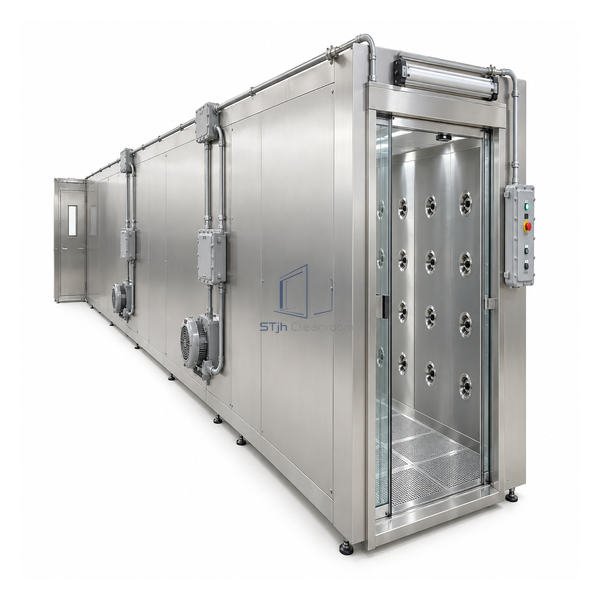
At 144 in overall depth, this is the longest accepted explosion-resistant configuration. The 136 in internal path and three blower sections support approximately four occupants or a longer staged passage. Stainless construction, pneumatic access and the cited Class I, Division 2 basis distinguish it from general cleanroom tunnels; the Group C and D lighting basis must still be reconciled with the actual site classification.
The 136 in chamber provides the greatest active travel and holding distance in this hazardous-location series.
Separate blower zones distribute filtered jet coverage along the extended tunnel.
Approximate four-person occupancy reduces the number of cycles needed during coordinated entries.
| Overall Size | 52 W x 144 D x 120 H in |
|---|---|
| Chamber Size | 35.5 W x 136 D x 83 H in |
| Approximate Capacity | 4 people |
| Blower Count | 3 |
| Air-System Arrangement | Three sectional blower systems |
| Area Classification Basis | Class I, Division 2 |
| Lighting Basis | Group C and D hazardous-location arrangement |
| Control Method | Pneumatic access interface |
| Cabinet Material | Stainless steel |
| Tùy chỉnh | Có sẵn dựa trên ứng dụng dự định và môi trường hoạt động. |
For coordinated personnel entry to higher-throughput clean hazardous processing facilities. The 12 ft body requires deliberate egress planning, distributed service access and verification that every selected component matches the site's gas or vapor classification.
Specify hazardous-location electrical package, pneumatic utilities, door arrangement, stainless grade, alarm interfaces and cycle programming. Final suitability depends on the documented area classification and process substances.
Gửi cho chúng tôi kích thước của bạn, điều kiện lắp đặt, mục tiêu hiệu suất và bề mặt yêu cầu hoàn thiện.