 Anglais
 Le portugais
 espagnol
 Le malais
 Indonésien
 Allemand
 Le turc
 Le vietnamien
 FrançaisCurrent
 russe
 Arabe
 Thaïlandais
 Japonais
 Coréen
Load-oriented access
Door width, clear height and enclosed transfer length can be selected together instead of relying on a personnel-sized opening.



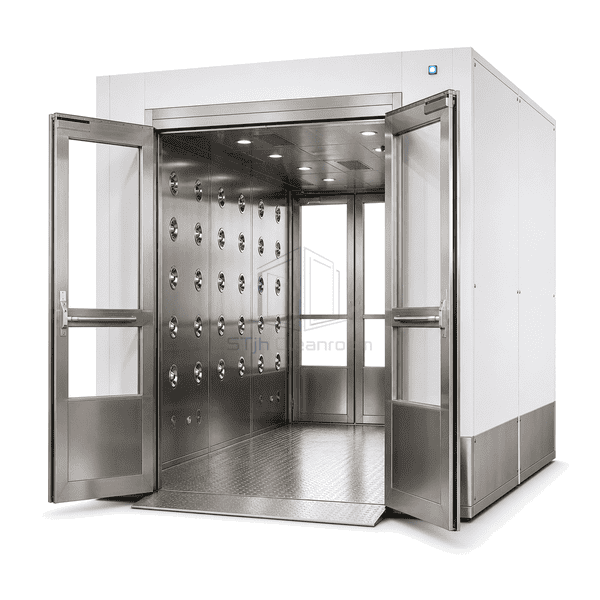
The cargo air shower combines a wide transfer enclosure with fan-filter compartments, directional nozzle panels and controlled doors at the material boundary. Air returns through the lower collection sections and is filtered before recirculation to the jets. The selected floor transition, doorway arrangement and protected lower surfaces suit movement of loaded carts rather than only a standing operator. Coated-steel and stainless construction choices allow the interior finish to match the cleaning routine.
Door width, clear height and enclosed transfer length can be selected together instead of relying on a personnel-sized opening.
Low-level return sections provide defined locations for inspecting packaging fibres and maintaining upstream filtration.
Hinged, sliding and roll-up packages address different requirements for adjacent space and overhead storage.
A ceiling-nozzle option addresses exposed load tops when the load geometry calls for another jet direction.
A cargo entrance must accommodate a moving load without confusing the nominal chamber size with the space the delivery actually needs.
Select the passage, jet and control package around your complete loaded transfer route. The paired dimensions below apply to one roll-up-door option; hinged and sliding-door layouts have their own dimensions. Chamber size and clear openings can be tailored to the load and handling equipment. These selectable references do not form one fixed performance rating.
| Transfer Format | Straight-through chamber for loaded trolleys, pallet-handling equipment or movable production equipment |
|---|---|
| Passage and Door Sizing | Custom-sized clear width, height and usable chamber length for the loaded handling envelope |
| Common Roll-Up-Door Layout Option | Roll-up-door reference: overall 1950 × 1500 × 2180 mm; clear chamber 1450 × 1430 × 1910 mm (W × D × H) |
| Body Material Options | Powder-coated steel, Type 304 stainless steel or coated exterior with stainless interior |
| Jet Arrangement | Directional sidewall nozzles; additional ceiling outlets available |
| Common Nozzle-Speed Class | 25 m/s-class nozzle-outlet configuration |
| Shower Timer Option | 0–99 s adjustable controller range |
| Particle Filtration | Return-air prefilter followed by HEPA final filtration |
| Common Electrical Variant | 380 V AC, three phase, 50 Hz |
| Cargo Door Options | Double-leaf hinged, sliding or roll-up doors with coordinated interlock control |
| Wheeled Access Options | Flush or low-threshold entry; selected base and impact protection for the handling route |
| Customisation | Disponible en fonction de l'application prévue et de l'environnement d'exploitation. |
A usual cargo arrangement combines filtered recirculation, side jets and a controlled transfer sequence. Door mechanism, upper outlets, floor structure and handling accessories are selected separately; pallet-jack or powered-cart suitability depends on the chosen dimensions and loading arrangement.
Include the pallet, wrapping, projecting handles, trolley frame and load overhang when recording the widest and highest points. For powered handling equipment, include the mast and operating position. Check the clear opening with the doors fully open, then allow enough chamber length for the complete load and handling equipment to be inside before either boundary is released. Overall enclosure dimensions, clear chamber dimensions and usable door openings are different measurements.
Record total loaded mass, individual wheel loads, wheel diameter, axle spacing and the route across the entrance. Decide whether the installation needs a flush recess, a baseplate transition or a short ramp; a level-looking floor does not establish a pallet-jack or forklift load rating. Keep wheels and load edges away from return grilles, nozzles and door safety devices.
Set the load position and outlet directions around the surfaces that are actually accessible. Roof jets can be selected for upper faces, but wrapping, stacked cartons and equipment recesses can shield particles from direct airflow. Loose external packaging may need removal before transfer. This dry particle blow-off step does not sterilize the load or clean enclosed product surfaces.
Review actual door travel, obstruction sensing, emergency release and power-loss behavior for the chosen mechanism. Obtain fan output, filter resistance, electrical demand and sound at the same cargo configuration; nozzle velocity alone is not chamber airflow or cleaning efficiency. Leave space to withdraw filters and service fans without blocking deliveries. Where overhead door storage is preferable to swing space, compare the roll-up door cargo air shower.
Envoyez-nous vos dimensions, conditions d'installation, objectifs de performance et finition de surface requise.