 Inglés
 Alemán
 El árabe
 Francés
 Idioma indonesio
 El japonés
 Coreano
 El malayo
 El portugués
 El ruso
 EspañolCurrent
 Tailandés
 El turco
 El vietnamita
Mineral panel body
The dense calcium-sulphate core provides a mineral alternative to woodcore construction for buyers selecting access flooring by internal material and overall panel behaviour.



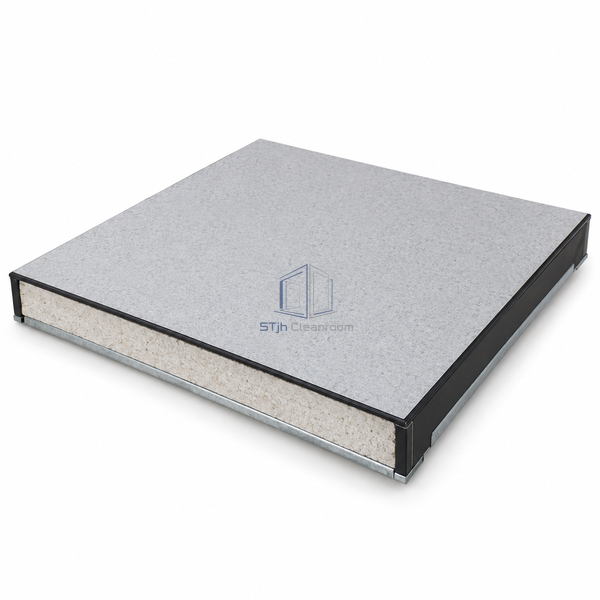
This panel uses high-density calcium sulphate as its core, with antistatic HPL on top and galvanized steel beneath. Conductive PVC banding protects the four edges while preserving the panel's modular form. The 600 mm grid suits technical room layouts where services must remain accessible. The construction differs from fully encapsulated panels because its perimeter protection is a separate edge band.
The dense calcium-sulphate core provides a mineral alternative to woodcore construction for buyers selecting access flooring by internal material and overall panel behaviour.
PVC perimeter protection can be visually checked when a panel is lifted. Damaged banding should be addressed before exposed core edges are returned to service.
The HPL face and steel underside perform distinct roles around the core. Panel thickness and supporting components should be selected together for the required room loading.
| Panel Grid | 600 x 600 mm |
|---|---|
| Panel Thickness Range | 30–40 mm |
| Core | Calcium sulphate |
| Core Density Reference | Approximately 1,650 kg/m³ |
| Top Surface | Antistatic HPL |
| Bottom Material | Galvanized steel sheet |
| Backing Thickness | 0.3–0.5 mm |
| Edge Band | Conductive PVC |
| Access Format | Individually removable panels |
| Customization | Disponible según la aplicación prevista y el entorno operativo. |
Use in laboratories, data rooms and controlled technical spaces that require a mineral-core access floor. Plan equipment supports and service openings so panels remain fully supported at their edges. The HPL and conductive banding should be integrated with the intended earthing arrangement when the space has specific electrostatic-control requirements.
Specify calcium sulphate explicitly together with the backing and edge-band construction so the complete panel is defined.
Inspect the conductive banding during service work and replace damaged edge protection before refitting the module.
Choose a supported panel thickness within the stated range, HPL finish and pedestal arrangement. Detail cut-outs with appropriate protection and local support instead of assuming the unmodified panel's capacity applies after cutting.
Envíenos sus dimensiones, condiciones de instalación, objetivos de rendimiento y acabado superficial requerido.