 Inglés
 Alemán
 El árabe
 Francés
 Idioma indonesio
 El japonés
 Coreano
 El malayo
 El portugués
 El ruso
 EspañolCurrent
 Tailandés
 El turco
 El vietnamita
Filter-side sealing blade
The continuous aluminum edge gives a defined interface with gel retained in the ceiling support grid.



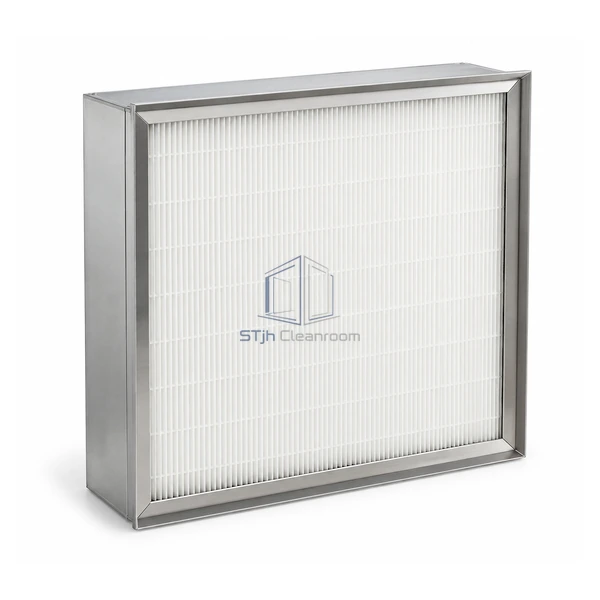
This version forms the knife edge directly into the anodized aluminum filter frame, pairing it with supported hydrophobic ePTFE media. The rigid blade enters gel retained by an open-plenum ceiling grid, so the replaceable panel carries no gasket or filled trough. Its low-outgassing membrane construction suits microelectronic and other sensitive mini-environments where both seal geometry and material emissions matter.
The continuous aluminum edge gives a defined interface with gel retained in the ceiling support grid.
Low-outgassing membrane and frame materials help reduce avoidable molecular contribution near critical equipment.
Gel remains in the grid, simplifying the replaceable element while shifting inspection to the ceiling receiver.
| Efficiency Class | H14 / at least 99.995% at MPPS |
|---|---|
| Membrane Media | Supported hydrophobic ePTFE |
| Frame Material | Anodized aluminum |
| Seal Interface | Integral knife edge |
| Gel Location | Ceiling-grid receiver |
| Material Emission | Low-outgassing construction |
| Pleat Type | Separatorless membrane mini-pleat |
| Installation | Common-plenum grid or mini-environment |
| Alignment Control | Match blade centerline and immersion depth to gel trough |
| Customization | Disponible según la aplicación prevista y el entorno operativo. |
Appropriate for common-plenum semiconductor cleanrooms, mini-environment ceilings and sensitive production zones using gel-filled grid receivers. The blade location, gel depth and frame tolerance must be coordinated before purchase because this filter cannot seal against a flat gasket land.
Define blade offset, frame depth, face dimensions, grille arrangement and low-outgassing material requirements for the grid.
Envíenos sus dimensiones, condiciones de instalación, objetivos de rendimiento y acabado superficial requerido.