
 Inglés
 El portugués
 EspañolCurrent
 El malayo
 Idioma indonesio
 Alemán
 El turco
 El vietnamita
 Francés
 El ruso
 El árabe
 Tailandés
 El japonés
 Coreano


FFU y equipos de purificación de aire terminal
Sistema de control central FFU
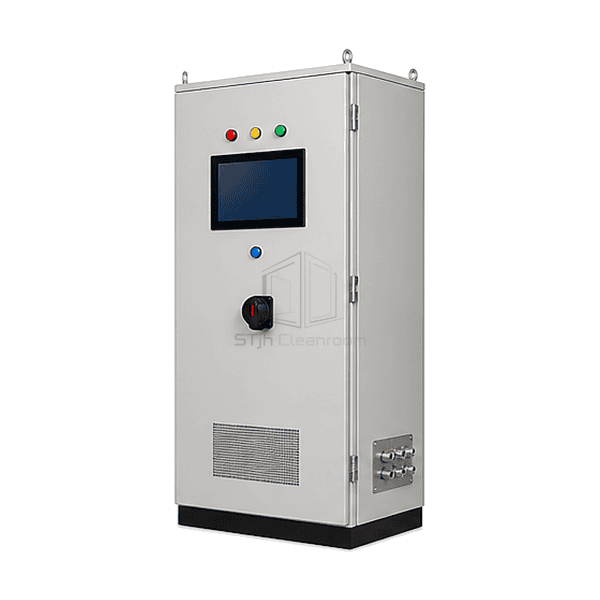
A cabinet-based supervisory system for organizing FFU commands and available feedback across multiple cleanroom zones.
- Multi-Zone Operating View
- Addressed Fan Organization
- Selectable Alarm Points
- BMS Interface Options
Introducción del producto
The FFU central control system brings the operator interface, network interfaces and control power components into a cabinet serving more than one cleanroom zone. Its screen layout can organize field units by room or process area, while compatible local fan electronics carry out the selected operating commands. This separates daily supervision from the individual FFU electrical assembly. The controller hardware, available feedback and software functions are selected together; a PLC, environmental sensors or historical database is included only when part of that architecture.
Características clave
Logical groups allow operators to select the intended area before applying an operating command.
A defined point list distinguishes commands, actual feedback and communications health.
Building-system integration can be selected without assuming that every field point should be remotely writable.
Soluciones para su aplicación
Central supervision is most valuable when its room map and command rules match the way the site is operated.
Operators cannot easily identify which FFUs serve a production area.Organize the screen and address schedule around named rooms, zones and equipment locations.
Local and building-system commands overwrite each other.Define control ownership and override priority instead of leaving several interfaces to issue conflicting instructions.
A lost network connection looks like a healthy stopped fan.Keep communication state separate from the commanded state and the feedback available from the drive.
Expansion adds devices that the original software cannot interpret.Choose an extensible address and interface plan using the actual control-card protocol and supported point definitions.
Aplicaciones típicas
Large semiconductor FFU ceilingsMulti-room pharmaceutical facilitiesBattery dry-room clean zonesDisplay and optics manufacturingCentral cleanroom operations centres
Parámetros técnicos
Common reference configuration choices for central FFU supervision.
| Control Level | Individual FFU, room-group and multi-zone supervisory commands |
|---|---|
| Operator Interface | Cabinet-mounted touchscreen HMI with a configured zone overview |
| Common HMI Supply | 24 VDC industrial-display configuration |
| Common Field Network | RS-485 with Modbus RTU for compatible addressed FFU control cards |
| Supervisory Interface Options | Modbus RTU, Modbus TCP over Ethernet, or a selected BACnet controller/gateway arrangement |
| Available Feedback Points | Run state, drive fault and communication status; speed feedback where provided by the fan electronics |
| Optional Operating Functions | Zone presets, schedules and alarm-event history in the selected software package |
| Enclosure Arrangement | Floor-standing or wall-mounted cabinet with segregated power and signal wiring |
| Customization | Disponible según la aplicación prevista y el entorno operativo. |
Opciones disponibles
Room-map or list-based HMI layoutAlarm-event history and selected trend pointsModbus or BACnet integration packageAdditional process-sensor inputs
Specify the required functions as a coordinated control package. An alarm-history option is not automatically a validated data-integrity system, and a process sensor is not supplied by the FFU network alone.
Selection and Installation
Build the control hierarchy around the facility
List the rooms, FFU addresses and operators who need access. Separate a system-wide command from a room command and from a maintenance override. If only one local zone needs coordination, compare the FFU group control panel before specifying a facility-wide supervisory cabinet.
Specify the actual interface at each boundary
Identify the fan-control card, supported protocol, register map and firmware at the field side. At the building system, define whether the connection is read-only monitoring or also permits writes, and assign command priority. An RS-485 terminal, Ethernet socket or BACnet label alone does not establish compatibility or expose the required points.
Keep electrical supply separate from signal definitions
The 24 VDC reference concerns an industrial HMI/control-electronics option, not fan-motor power or cabinet incoming mains. Size the cabinet supply, protective devices and field circuits for the actual equipment. A 0-10 V command is a signal interface; it must not be treated as a power supply or connected directly to a mains-speed controller.
Test loss and recovery behavior
Define what each FFU does after communication loss, controller restart and power restoration. Demonstrate group mapping, stale-data indication, alarm acknowledgement and the return from a local override. Schedules and setback levels should follow the facility's operating requirements rather than an assumed energy-saving percentage. A displayed speed value is not an independent airflow or particle-count measurement.
Planning a FFU Central Control System specification?
Envíenos sus dimensiones, condiciones de instalación, objetivos de rendimiento y acabado superficial requerido.