 Inglês
 Portuguêsatual
 Espanhol
 Língua malaia
 Língua indonésia
 Alemão
 Língua turca
 Vietnã
 Francês
 Língua russa
 Língua árabe
 Tailandês
 Japonês
 Coreano
Covered liquid preparation
The vessel and dosing arrangement reduce the need to prepare each application by open manual pouring.



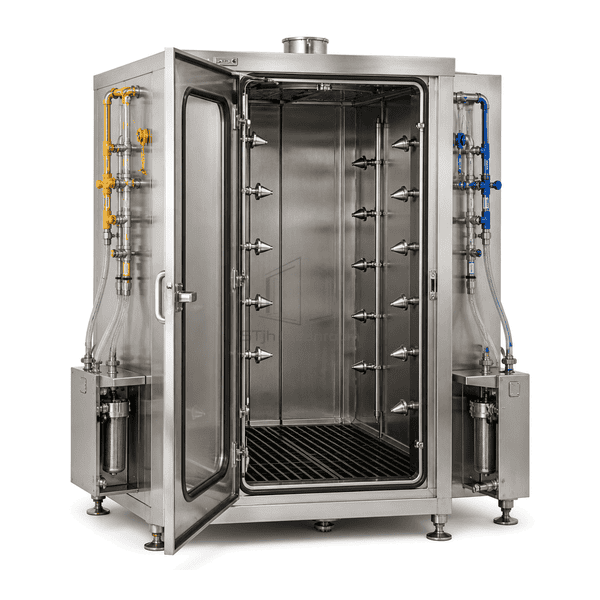
This decontamination shower combines a covered preparation vessel, dosing pump and distribution manifold for applying a selected liquid to the exterior of compatible protective suits. The treatment supply is separated from the final water-rinse branch, and the collection tray directs spent liquid to a designated outlet. The chamber and liquid-preparation equipment form distinct service areas. Pump components, seals and pipework are selected for the intended chemistry rather than assumed to share the enclosure's material.
The vessel and dosing arrangement reduce the need to prepare each application by open manual pouring.
A distinct water branch allows rinsing to be scheduled after solution application instead of relying on the treatment feed alone.
Tank, pump and seal choices can reflect different chemical exposures within the same installation.
Locating preparation and distribution components outside the occupied chamber supports servicing without treating them as hidden wall components.
A suit-treatment process depends on the delivered liquid and the garment being treated, not the chamber material alone.
Use is limited to a selected suit, liquid and contaminant combination. The general configuration does not establish a BSL classification, respiratory protection, safe suit removal, sterilization or complete toxic-agent removal.
These construction and equipment selections are reference options for a chemical protective-suit treatment chamber. Sheet gauges and material choices are not a confirmed STjh build specification or evidence of decontamination effectiveness for a particular agent.
| Treatment Format | Enclosed suit-spray chamber with separate liquid-preparation equipment |
|---|---|
| Chamber Material Option | SUS 316L stainless steel wetted enclosure surfaces |
| Enclosure Sheet Reference | 0.8–1.5 mm stainless steel sheet |
| Solution Preparation | Covered preparation tank with metering-pump feed |
| Delivery Circuit | Pump-fed treatment manifold and a separate water-rinse supply |
| Sequência de palco | Solution application, adjustable contact interval and water rinse |
| Spray Layout | Multiple treatment outlets arranged around the occupied suit position |
| Process Monitoring Options | Liquid-level indication and chemical usage or concentration monitoring |
| Configuração da porta | Two personnel doors with interlock controls |
| Drain Collection | Chamber collection tray with a designated effluent outlet |
| Sistema de Controle | PLC-controlled treatment and rinse stages with status indication |
| Service Layout | Separately accessible tank, pump, valves and liquid-distribution connections |
| Customização | Disponível com base na aplicação pretendida e no ambiente operacional. |
The basic suit-treatment arrangement comprises an enclosed spray area, preparation and dosing equipment, a separate water rinse and an identified liquid outlet. Tank heating, monitoring and runoff handling are selected additions. A circulation or liquid-reuse arrangement must be specified explicitly; it is not an assumed benefit of every chemical suit shower.
Identify the protective-suit material, seams, visor, gloves and connected equipment before choosing a treatment liquid. Include the pump, seals, nozzles, tank and pipework in the compatibility assessment. A stainless enclosure is not resistant to every chemical, and a treatment intended for a suit exterior is not automatically suitable for exposed skin or a respirator.
Specify chemical identity, working concentration, application and contact intervals, rinse requirements and the intended garment position together. Metering and timed control help deliver a selected process; they do not establish neutralization, microbial kill or removal of every contaminant. Suit folds and connections require particular attention when checking the spray pattern and process result.
Define whether a return line recirculates prepared solution before delivery or returns liquid collected from the chamber. These are different arrangements. Used runoff should not be assumed suitable for reuse merely because the equipment has a pump or circulation pipe. Keep the final-rinse source, backflow provisions and waste route identified separately from the treatment supply.
Allow for the occupied chamber, preparation equipment and maintenance access, not just the doorway footprint. Establish how spent solution is collected and transferred to the facility's designated waste system; the chamber drain does not treat the effluent. Ventilation and any breathing-air connection require their own selected design. Where the requirement is a water-wash stage for personnel rather than chemical application to a suit, compare the personnel decontamination shower.
Envie-nos as suas dimensões, condições de instalação, metas de desempenho e acabamento de superfície necessário.