 EnglishCurrent
 德语
德语 阿拉伯语
阿拉伯语 法语
法语 印尼语
印尼语 日语
日语 韩语
韩语 马来语
马来语 葡萄牙语
葡萄牙语 俄语
俄语 西班牙语
西班牙语 泰语
泰语 土耳其语
土耳其语 越南语
越南语Negative-pressure architecture
The reversed flow path supports drawing air from an isolation space before routing filtered discharge away through ducting.



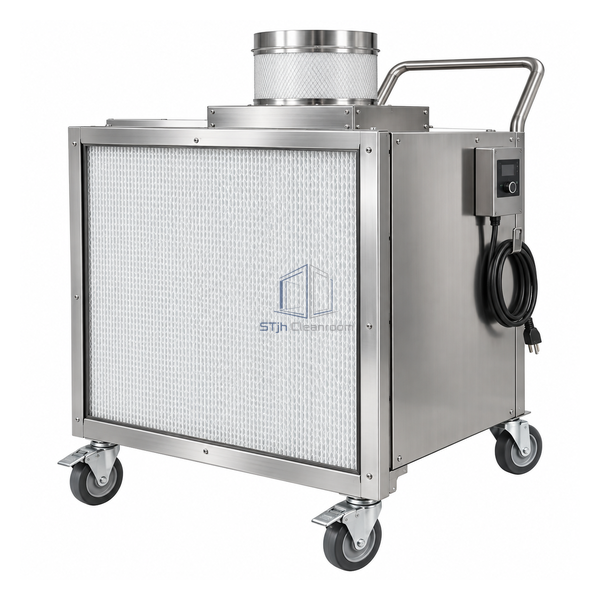
The reverse-flow mobile FFU is arranged for temporary negative-pressure or isolation-room work rather than in-room recirculation. Air is drawn through the visible filter face and discharged from the fan side to a connected duct route. The 48 x 24 x 13.7 in module supplies up to 1100 CFM and can use a 99.99% at 0.3 µm HEPA filter or optional ULPA stage within a 304 stainless mobile assembly.
The reversed flow path supports drawing air from an isolation space before routing filtered discharge away through ducting.
The standard HEPA filter can be upgraded to ULPA where the application calls for a higher-efficiency particulate barrier.
Casters, handle and plug cord support temporary deployment without converting the unit into fixed building equipment.
| Fan-Filter Module Size | 48 x 24 x 13.7 in |
|---|---|
| Maximum Airflow | 1100 CFM |
| Airflow Arrangement | Room-side intake through filter with ducted fan-side discharge |
| Standard Final Filter | HEPA, 99.99% at 0.3 µm |
| Optional Final Filter | ULPA |
| Housing Material | 304 stainless steel |
| Mobility | Casters and push handle |
| Electrical Connection | Portable plug cord |
| Operating Mode | Temporary negative-pressure or isolation support |
| Customization | Available based on the intended application and operating environment. |
Designed for temporary isolation-room conversion, negative-pressure work zones and containment support where filtered discharge is routed to a suitable destination. The duct path, room leakage and required pressure offset must be confirmed on site.
Specify HEPA or ULPA filtration, discharge adaptor, flexible or rigid duct interface, fan control and electrical connection. The exhaust destination and pressure setpoint remain part of the site ventilation design.
Send us your dimensions, installation conditions, performance targets and required surface finish.