
 EnglishCurrent
 葡萄牙语
 西班牙语
 马来语
 印尼语
 德语
 土耳其语
 越南语
 法语
 俄语
 阿拉伯语
 泰语
 日语
 韩语


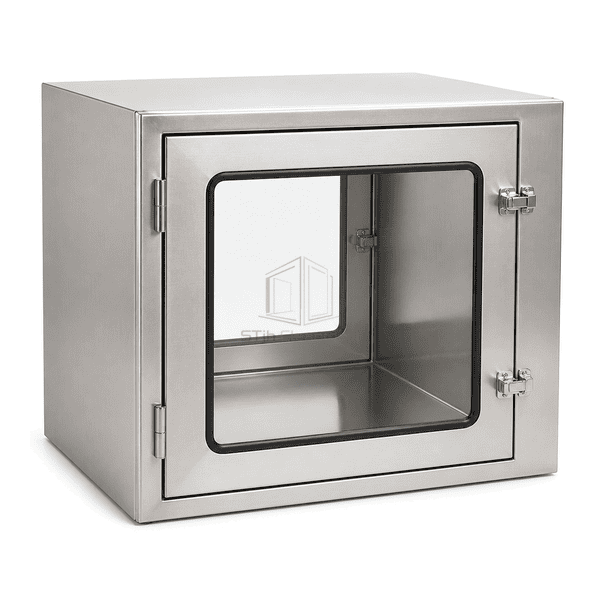
Personnel and Material Decontamination Equipment
Static Cleanroom Pass Box
A non-ventilated stainless transfer cabinet that separates two rooms through sealed, interlocked doors.
- Non-Ventilated Transfer Chamber
- Dual-Door Interlock
- Smooth Lipless Interior
- Gasketed Door Closure
Product Introduction
This wall-mounted pass box provides a dedicated route for small materials without moving personnel between rooms. A double-wall body keeps the door linkage outside the usable transfer space, while a flat stainless floor gives trays a continuous sliding surface. The enclosed chamber can be reached from either room for wiping, and glazed doors allow staff to see whether a load remains inside. It is a passive barrier between sequential door openings, not an air-treatment cabinet.
Key Features
The uninterrupted sill reduces obstacles when moving shallow trays.
Windowed doors let staff check occupancy before reaching into the cabinet.
Replaceable closure seals allow wear points to be serviced separately.
A mechanical interlock can be selected where powered accessories are unnecessary.
Solutions for Your Application
Choose the hatch around the physical transfer task and the way its two sides will be operated.
Staff carry small supplies through a full-sized room doorway.A dedicated hand-transfer opening avoids that unnecessary personnel movement.
Both sides are opened while a container is still being handled.Select interlocking hardware that holds the opposite door closed during access, with a clear recovery method for faults.
Long trays fit inside but strike the doorway or latch.Check the actual clear aperture, hinge intrusion and tray grip space rather than buying on chamber volume alone.
Powder or packaging debris collects around internal fittings.Keep the usable floor clear of exposed linkage and select corner and sill details that can be reached during wiping.
Typical Applications
Wrapped packaging supplies between compatible clean areasSmall medical-device components in covered traysElectronics tools and assembly fixturesClosed laboratory sample containers
Use the static arrangement for a transfer route whose material preparation is handled separately. It does not sterilize packaging, remove airborne contamination within the chamber or provide hazardous-material containment.
Technical Parameters
The following are commonly selectable construction references for passive transfer cabinets, not measured specifications of a particular STjh assembly. Chamber dimensions describe the usable enclosure; the wall opening and external body require additional space.
| Transfer Principle | Passive two-door chamber without a circulation fan or HEPA air-cleaning stage |
|---|---|
| Internal Chamber Size References | 500 × 500 × 500, 600 × 600 × 600 or 800 × 800 × 800 mm, W × D × H |
| Chamber Material | 304 stainless steel; 316L construction selectable |
| Enclosure Sheet References | 1.0 or 1.2 mm stainless sheet for selected body and liner parts |
| Door Arrangement | Opposed manually operated doors with viewing windows |
| Interlock Selection | Mechanical linkage or electrically controlled one-door-at-a-time locking |
| Closure Components | Perimeter door gasket and compression-latch arrangement |
| Interior Construction | Smooth transfer floor with accessible corners and concealed interlock hardware |
| Mounting Arrangement | Through-wall cabinet with perimeter finishing frames |
| Customization | Available based on the intended application and operating environment. |
Available Options
Mechanical or electronic door interlock304 or 316L stainless constructionOpaque or windowed doorsAlternative chamber proportionsWall-depth finishing framesSupport stand for the handling height
The normal starting point is a stainless chamber with two gasketed doors and a selected interlock. Powered status indication and access-control functions can be added with the electrical version. Dimensions and mounting details can be customized without introducing a fan or filtration stage into the passive transfer principle.
Selection and Installation
Size the opening around the largest tray or container, including its handles and the operator's grip. The clear door aperture can be smaller than the chamber, so a nominal 600 mm cube is not a promise that a 600 mm-wide load will pass through. Locate the transfer floor at a comfortable handling height and support the cabinet independently of lightweight wall finishes where necessary.
A passive hatch does not clean the material or replace the room's pressure-control system. Use it with a defined exterior-wiping and packaging-transfer practice. Where the transfer process also needs an internal filtered-air cycle, compare the HEPA-filtered dynamic pass box rather than adding a blower specification to this static model.
Planning a Static Cleanroom Pass Box specification?
Send us your dimensions, installation conditions, performance targets and required surface finish.