 EnglishCurrent
 葡萄牙语
 西班牙语
 马来语
 印尼语
 德语
 土耳其语
 越南语
 法语
 俄语
 阿拉伯语
 泰语
 日语
 韩语
One station for changing layouts
The air-treatment components travel with the supporting frame when an indoor work cell is rearranged.



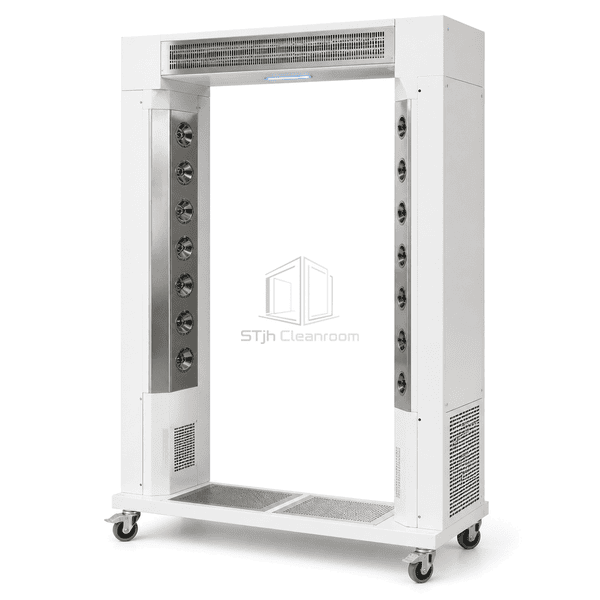
This mobile unit is a doorless ionizing pass-through portal, not a wheeled enclosed air-shower booth. Side housings carry the air equipment and ionizing components, while a bridged frame defines the personnel opening. The wheeled support lets the station follow changes in an indoor work-cell layout; locking casters and adjustable feet secure its operating position. Removable covers provide access to the service components without treating the frame as a permanent partition.
The air-treatment components travel with the supporting frame when an indoor work cell is rearranged.
The unenclosed treatment position avoids adding swing-door clearance around a temporary workstation.
Ionizing elements supplement the air stream where electrostatic attraction makes loose particles cling to garments.
Access to the ionizing components allows their cleaning needs to be considered alongside filter replacement.
A movable treatment point needs a repeatable setup each time its location changes.
Suitable tasks concern ordinary loose garment particles and static attraction. Hazardous powders, combustible dust and chemical or biological decontamination are outside this general-purpose portal configuration.
These are common selectable construction and utility references for a blower-based mobile ionizing portal. They describe configuration choices, not measured performance or an as-built rating for one STjh unit.
| Equipment Format | Doorless personnel portal with side equipment housings and an open connecting frame |
|---|---|
| Mobile Support | Wheeled base with locking casters and adjustable leveling feet |
| Construction Options | Coated steel equipment housings with steel or aluminum support framing |
| Air Supply Configuration | Electric blower feeding filtered air to garment-facing outlets |
| Ionizing Assembly | Ionizing emitters positioned in the treatment air path |
| Outlet Arrangement | Side-mounted outlet banks; adjustable stainless steel nozzle option |
| Filtration Options | Replaceable prefilter and HEPA final filter; H14 element option |
| Start and Timing Options | Manual or photoelectric start with an adjustable blowing interval |
| Electrical Supply References | 110–120 or 220–240 V AC, single-phase, 50/60 Hz supply variants |
| Service Access | Removable equipment covers for filter, blower and ionizing-component maintenance |
| Customization | Available based on the intended application and operating environment. |
The basic arrangement is an open portal on a lockable wheeled base with an ionizing air-treatment package. The blower, filtration, controls and service clearances are selected as one configuration. A partition connector or access ramp is a separate interface option, not an airtight boundary or an automatic part of the mobile base.
Allow for the complete frame, caster sweep, floor joints and the route between work cells. Move the portal only after shutdown and disconnection of its services. Lock the casters and set the leveling feet on a suitable level floor before use; wheels do not provide permanent stability by themselves. Keep the pedestrian approach clear of the base and service cables.
The reference arrangement uses an electric blower and filtered supply air. A compressed-air ionizing head is a different utility package: its pressure, consumption and suitability for personnel use cannot be inferred from an industrial parts-cleaning nozzle. Specify the supply source, filters, inlet path and outlet arrangement together. An inlet grille is not proof that released particles are captured.
Include emitter access and the manufacturer's cleaning method in routine maintenance. Check treatment at the actual working distance and garment position after a move. Ionization can address static attraction, but it does not establish a charge-decay result, ion balance, ozone limit or an ESD-compliant personnel grounding system.
Select this format for ordinary non-hazardous garment particles where an enclosed entry chamber is not required. Evaluate nearby room air currents and the destination of dislodged particles before positioning it near exposed work. This is not a sealed cleanroom boundary, a sterilizer or hazardous-dust containment equipment. For a permanent doorway arrangement instead of a movable base, compare the fixed doorway blow-off portal.
Send us your dimensions, installation conditions, performance targets and required surface finish.