 영어
영어 독일어
독일어 아랍어
아랍어 프랑스어
프랑스어 인도네시아어
 일본어
일본어 한국어현재 Current
 말레이어
말레이어 포르투갈어
포르투갈어 러시아어
러시아어 스페인어
스페인어 태국어
태국어 터키어
터키어 베트남어
베트남어Base-specific adsorption
The media chemistry is selected for alkaline contaminants rather than acid gases or broad VOC loading.



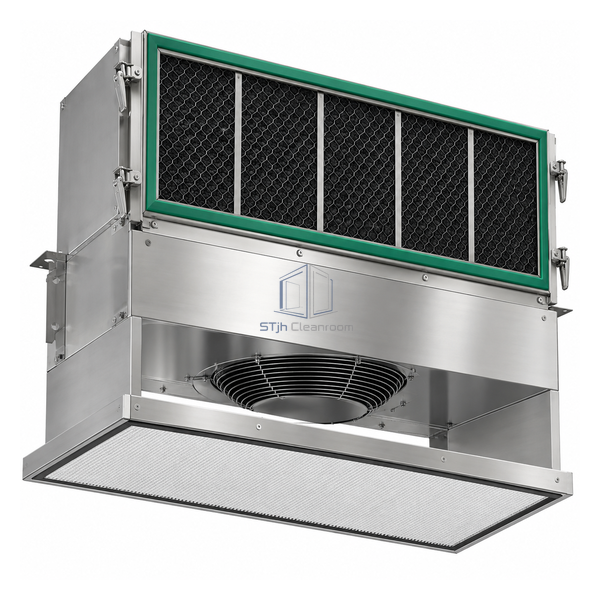
This chemical-filter FFU configuration is designed around alkaline airborne molecular contaminants, especially ammonia and amines. An impregnated activated-carbon panel is installed upstream of the fan filter unit so base-gas adsorption occurs before particle filtration. The cited molecular-filter family uses a 30-70% RH operating range, which makes humidity control an important part of media selection and service planning.
The media chemistry is selected for alkaline contaminants rather than acid gases or broad VOC loading.
The cited 30-70% RH range provides a clear boundary for evaluating the chemical stage in the actual cleanroom.
The panel sits before the FFU, allowing molecular control to be combined with the downstream particle filter.
| Target Contaminants | Ammonia and amines |
|---|---|
| Chemical Media | Impregnated activated carbon selected for base gases |
| Chemical Filter Form | Replaceable panel filter |
| Installation Position | Upstream of the FFU |
| Reference Humidity Range | 30-70% RH for the cited molecular-filter family |
| Final Particle Filter | HEPA or ULPA selected for the application |
| Airflow Direction | Base-gas media to FFU to final particle filter |
| Media Selection Basis | Measured alkaline AMC profile and airflow duty |
| Housing Interface | Sealed panel frame matched to the FFU |
| 사용자 정의 | 의도된 응용 프로그램 및 운영 환경에 따라 사용할 수 있습니다. |
Intended for photoresist processing, lithography support and precision microelectronics areas where ammonia or amines can alter process chemistry. The room humidity and contaminant profile should be reviewed because adsorption performance and service life depend on both.
Specify the alkaline contaminant profile, media chemistry, panel depth, FFU adaptor, final filter and service access. Confirm performance for the real humidity, temperature and airflow conditions.
치수, 설치 조건, 성능 목표 및 필요한 표면 마감을 보내십시오.