 Anglais
 Le portugais
 espagnol
 Le malais
 Indonésien
 Allemand
 Le turc
 Le vietnamien
 FrançaisCurrent
 russe
 Arabe
 Thaïlandais
 Japonais
 Coréen


Equipement de décontamination du personnel et du matériel
ZUV-C Matériau Traitement Pass Box
An enclosed two-door UV-C chamber for timed exposure of accessible surfaces on suitable transfer materials.
- Shielded UV-C Lamps
- Timed Exposure Control
- Door-Linked Lamp Control
- Reflective Chamber Interior
Introduction de produit
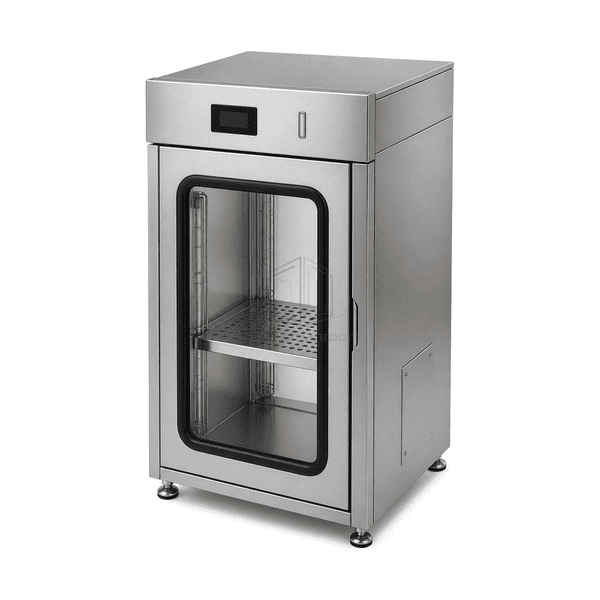
The UV-C material treatment pass box incorporates lamps within a two-door stainless transfer chamber. A timer controls the selected exposure period, while the specified door-linked circuit is arranged to interrupt lamp operation during access. Lamp guards and a removable support separate the load from the fittings. This configuration addresses UV-accessible package surfaces; it does not turn a closed or shadowed object into a uniformly treated load.
Key Features
Adjustable exposure control accommodates a defined loading routine.
A removable shelf provides access to the lower chamber for cleaning.
Reflective interior surfaces form part of the selected optical arrangement.
Optional operating-hour tracking supports lamp-service planning.
Des solutions pour votre application
The suitable loading pattern and access arrangement matter as much as the installed lamps.
Packages overlap and conceal the surfaces of interest.Reduce the loading density or use a defined repositioning method; do not assume reflections reach the obscured faces.
A person could open a door during exposure.Select a door-linked lamp interruption and shielding package, with its real access and restart behavior checked as one assembly.
The lamp remains visibly lit after useful output has declined.Combine cleaning and replacement intervals with an appropriate output check; elapsed hours alone cannot establish the delivered exposure.
Repeated cycles discolor a label or weaken a polymer part.Assess the actual material and cumulative exposure, then choose compatible packaging or a different transfer-treatment method.
Les applications typiques
Compatible closed sample-container exteriorsSelected secondary-packaging surfacesSmall non-medical production toolsUV-compatible transfer carriers
Choose the load and intended exposed surfaces individually. This chamber is not an assumed medical-device reprocessor, personnel treatment system or validated sterile-transfer barrier, and it does not replace cleaning of dirty surfaces.
Paramètres techniques
These common selectable references describe the cabinet and UV-C control arrangement, not a tested STjh exposure process. Lamp wavelength, electrical input and timer settings are different quantities; none alone establishes dose at a package surface, complete coverage or a microbial reduction result.
| Treatment Mode | Enclosed UV-C exposure of accessible material surfaces |
|---|---|
| Matériau de l'armoire | Acier inoxydable SUS 304 |
| Internal Size References | 500 × 500 × 500 mm or 600 × 600 × 600 mm, W × D × H |
| Stainless Sheet Reference | 1.0 mm nominal sheet option |
| UV-C Source Reference | 254 nm lamp option |
| Lamp Placement | Recessed or guarded positions within the treatment chamber |
| Exposure Control | Adjustable cycle timer |
| Door-Linked Lamp Control | Door-operated lamp cut-off circuit |
| Load Support | Removable perforated shelf; alternative supports available |
| Maintenance Indication | Cumulative lamp operating-hour counter option |
| Electrical Supply Reference | 230 V AC, 50 Hz equipment option |
| Customisation | Disponible en fonction de l'application prévue et de l'environnement d'exploitation. |
Options disponibles
254 nm UV-C lamp packageLamp operating-hour counterLocal UV-intensity sensorAlternative removable load supportsAdditional guarded lamp positionsTransfer-cycle status indication
The usual arrangement comprises the stainless enclosure, lamp fittings, timer, load support and door-linked controls. Lamp count, spectrum, measuring hardware, shielding and maintenance provisions are selected together; adding more lamps or a sensor does not by itself establish a treatment endpoint.
Selection and Installation
Define the surface, not just the item
State which external faces must receive UV-C and how the package is positioned during each exposure. Closures, overlaps, stacked objects and the points resting on a shelf can remain shadowed. A reflective lining or perforated support does not establish treatment of those concealed areas, internal contents or material beneath an opaque wrapper. Remove visible soil using an appropriate cleaning method before considering UV-C exposure.
Select a process without borrowing another chamber's cycle
Determine the required exposure with the actual lamp type, distance, load and maintained output. Rated lamp watts are not irradiance at the package, and a 254 nm wavelength is not a dose. There is no general seconds setting or universal reduction percentage for every load. A local UV sensor observes its own measuring position; a timer and hour counter are not substitutes for evidence of the intended surface treatment.
Specify access controls as a complete assembly
UV-C can injure eyes and skin; access must not expose people to an energized source. Select shielding, viewing material, door switches and lamp-power interruption together, including opening, power restoration and maintenance behavior. The proposed door-linked circuit is not a claim of independently verified safety integrity or proof that an ordinary window blocks the installed lamp spectrum. Identify whether the selected lamp can generate ozone and address any resulting ventilation and release requirements; do not assume the chamber is ozone-free from the wavelength label alone.
Protect materials and maintain the chamber
Check compatibility of plastics, elastomers, labels, adhesives and the product itself with repeated exposure. Reserve access for cleaning lamps and reflectors, changing the selected source and checking the door controls. A failed or visibly glowing lamp is not evidence of adequate UV-C output. If the intended task is instead ordinary non-UV material transfer, compare the static cleanroom pass box.
Planning a UV-C Material Treatment Pass Box specification?
Envoyez-nous vos dimensions, conditions d'installation, objectifs de performance et finition de surface requise.