
 영어
 포르투갈어
 스페인어
 말레이어
 인도네시아어
 독일어
 터키어
 베트남어
 프랑스어
 러시아어
 아랍어
 태국어
 일본어
 한국어현재 Current


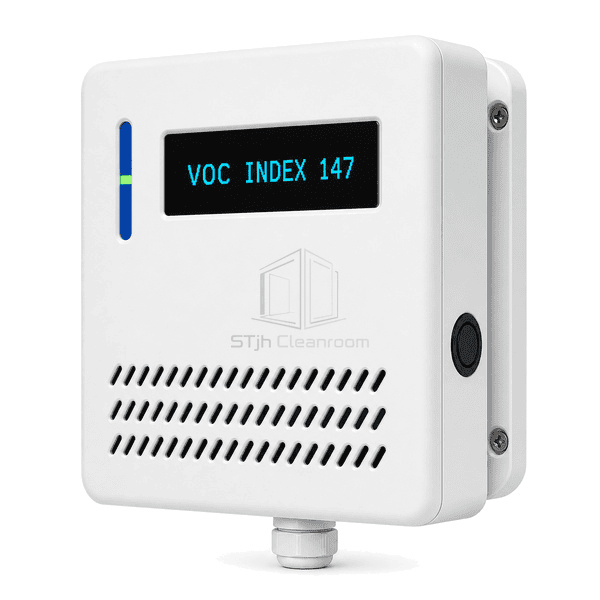
클린룸 제어 및 환경 모니터링 시스템 (Cleanroom Control and Environment Monitoring Systems)
VOC 센서
A metal-oxide air quality sensor that tracks changing mixtures of volatile organic compounds and provides a compensated trend signal for ventilation or monitoring.
- Metal-Oxide VOC Detection
- Mixed-Gas Trend Signal
- Humidity Compensation
- Ventilation Control Output
상품 소개
The VOC air quality sensor uses a heated metal-oxide element whose surface resistance changes when reducing or oxidizing organic vapors are present. Embedded algorithms compensate for temperature and humidity effects and convert the raw response into a VOC index or equivalent concentration trend. The device is intended for changes in mixed indoor VOC load rather than identification of one specific compound. A ventilated wall or duct enclosure exposes the element to the monitored air while keeping power and communication terminals protected.
주요 기능
Temperature and humidity compensation stabilizes the index across normal room conditions.
A trend-oriented output supports demand ventilation and environmental anomaly detection.
Wall and duct formats place the sensor where solvent or cleaning-vapor changes occur.
응용 프로그램 솔루션
A broad VOC sensor reacts to mixtures and background changes, so it should not be treated as a compound-specific analytical instrument.
Users expect one VOC index to identify an individual chemical.The system presents the reading as a mixed-gas trend and uses compound-specific detectors where selectivity is required.
Humidity changes create an apparent VOC shift during HVAC transitions.Integrated humidity compensation reduces normal environmental cross-sensitivity.
A freshly installed sensor needs time to establish a stable background.Warm-up and baseline handling allow the metal-oxide element to settle before alarm evaluation.
Cleaning spray contacts the sensing surface directly.Protected diffusion openings and appropriate mounting separate the element from liquid droplets.
일반적인 응용 프로그램
Cleanroom solvent-vapor trendingCleaning process monitoringLaboratory air qualityVentilation demand indication
기술 매개변수
Typical construction values for a cleanroom VOC air quality sensor are shown below.
| 핵심 재료 | Metal-oxide semiconductor sensing element on FR-4 board in flame-retardant polycarbonate enclosure |
|---|---|
| 패널 두께 | 25-45 mm housing depth |
| 유효 폭 | 80-120 mm housing width |
| 최대 길이 | Up to 150 mm enclosure height |
| 강철 면면 두께 | 0 mm; non-metallic sensor housing |
| 코어 밀도 | 1180-1220 kg/m³ for polycarbonate enclosure parts |
| 열전도도 (Thermal Conductivity) | 0.19-0.22 W/(m·K) for polycarbonate housing material |
| 표면 마무리 | Matte white housing with blue air-quality indicator and protected vent pattern |
| 접합 유형 | Snap-fit wall enclosure with rear terminal block and replaceable vent filter |
| 사용자 정의 | 의도된 응용 프로그램 및 운영 환경에 따라 사용할 수 있습니다. |
사용 가능한 옵션
VOC index or equivalent concentration outputWall or duct mountAnalog or digital communicationIntegrated temperature and humidity compensation
Planning a VOC Sensor specification?
치수, 설치 조건, 성능 목표 및 필요한 표면 마감을 보내십시오.