 English
 Немецкий
 Арабский язык
 Французский
 Индонезийский
 Японский язык
 Корейский
 Японский
 Португальский
 Русский языкТекущий
 Испанский язык
 Тайский
 Турецкий
 Вьетнамский язык
Large-line concurrency
A standalone wireless network can manage and operate as many as 48 configured units at the same time.



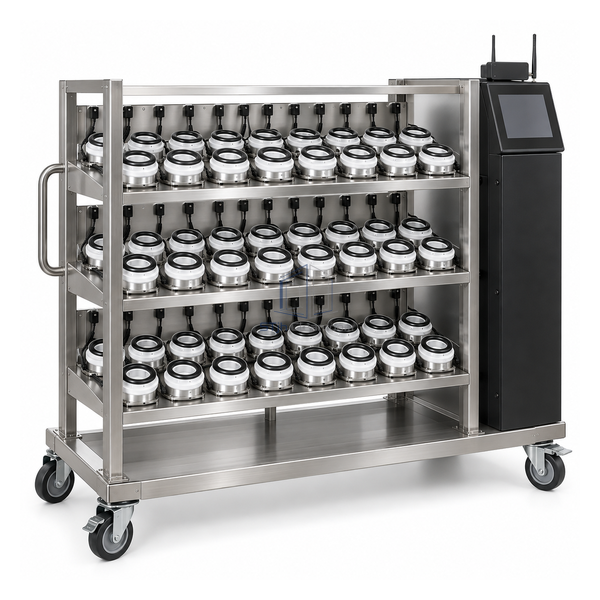
The 48-head architecture is intended for large filling lines and multi-module barriers where port count, result association and user access become fleet-management issues. Central software supervises parallel tests, maps heads by RFID and can exchange information through optional OPC or SQL interfaces rather than leaving each instrument as a separate record source.
A standalone wireless network can manage and operate as many as 48 configured units at the same time.
User roles, audit trails and signed reports support review of who ran each port test and under which recipe.
Optional OPC or SQL interfaces allow the glove-test dataset to enter an existing automation or information architecture.
| Maximum Network Size | 48 wireless test heads |
|---|---|
| Parallel Operation | Up to 48 glove tests |
| Measurement Method | ISO 10648-2-based pressure decay |
| Detectable Leak Class | 100 µm and above |
| Wireless Communication | ZigBee protocol |
| Port Mapping | RFID identification |
| Stored Test Recipes | Up to 9 glove recipes |
| User Access Levels | Up to 6 configurable roles |
| Data Interfaces | Optional OPC and SQL |
| Customization | Head quantity, port discs, recipe library, reporting and integration interfaces can be configured for the barrier network and operating environment. |
High-port-count aseptic filling isolators, multi-cell process barriers and large RABS installations requiring synchronized integrity testing and centralized records.
Network size up to 48 heads, port-specific discs, trolley groups, cleanroom tablets, Active Directory user management, OPC connection and SQL export may be specified.
Отправьте нам ваши габариты, условия монтажа, целевые показатели производительности и требуемую отделку поверхности.