 English
 Португальский
 Испанский язык
 Японский
 Индонезийский
 Немецкий
 Турецкий
 Вьетнамский язык
 Французский
 Русский языкТекущий
 Арабский язык
 Тайский
 Японский язык
 Корейский
Treatment without deliberate wetting
The dry process avoids adding a spray stage when the residue and garment are suitable for air treatment.



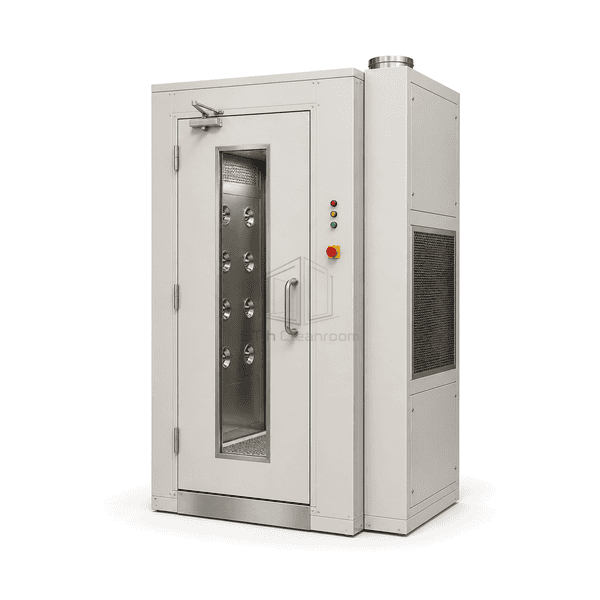
The protective suit de-dusting booth brings air outlets and a collection section around a wearer in coveralls. Its nozzle fittings address exposed garment areas, while the selected filter assembly receives air carrying the disturbed particles. The enclosure includes a personnel doorway and access to the extraction equipment; lining, nozzle positions and service orientation can be specified separately. This is a dry surface-treatment arrangement, without a water-spray or detergent dosing stage.
The dry process avoids adding a spray stage when the residue and garment are suitable for air treatment.
The selected nozzle layout can account for sleeves, lower legs and the space occupied by a hood rather than assuming an uncovered standing body.
The initial collection element can be selected for the incoming dust load, leaving a downstream element for the finer fraction.
An optional filter-pressure indicator helps identify a change in resistance that calls for inspection of the collection stage.
A useful suit-treatment routine must respect the coverall's construction as well as the material on its surface.
These are coverall surface-cleaning tasks, not chemical neutralization, toxic-gas desorption, biological decontamination or a guarantee that protective clothing can be removed safely. An unidentified process powder must not be treated as ordinary dust simply because it is dry.
The selections below describe common dry personnel-booth components and an individual-use layout. They are reference choices for compatible coveralls carrying non-hazardous, non-combustible dry particles, not the measured duty or protective performance of a fixed STjh model.
| Treatment Method | Dry-air removal of loose particles from outer garment surfaces |
|---|---|
| Personnel Layout Option | Single-wearer standing treatment position |
| Booth Material Options | Coated steel enclosure; stainless steel lining or casing alternative |
| Cleaning-Air Supply | Electric blower with filtered supply air |
| Outlet Construction | Adjustable stainless steel air nozzles |
| Collection Assembly | Extraction fan, filter compartment and removable dust receptacle |
| Primary Collection Options | Replaceable pleated-panel filters or dust-collection cartridges |
| Final Filtration Option | HEPA after-filter downstream of the selected primary collection stage |
| Filter Monitoring Option | Differential-pressure indication across the collection filters |
| Operating Controls | Door-closed blow-off permissive, user start and emergency stop |
| Post-Blow Control Option | Timed extraction run-on after the cleaning jets stop |
| Supply Reference | 230 V AC, single-phase, 50/60 Hz equipment variant |
| Customization | Доступно в зависимости от предполагаемого применения и операционной среды. |
The starting package is a metal booth with garment-facing outlets and a defined dust-collection assembly. The occupied space, supply circuit, service side and operating controls are selected around the intended coverall. Protected bag-out or safe-change housings require a separately specified system and are not implied by ordinary service doors.
Identify the coverall material, seams, zipper flap, hood, cuffs, footwear covers and any attached equipment. Follow the garment maker's permitted care and handling method; an air-cleaning cycle does not restore its chemical barrier or authorize reuse of limited-use clothing. Gas-tight suits, air-fed ensembles and garments with valves or exposed seals need their own compatibility assessment. Do not connect suit breathing-air equipment to the booth's cleaning-air circuit.
Plan individual treatment rather than placing several people in the booth because they fit through the door. Allow for the hood, elbows, boots and any permitted turning movement without rubbing the garment against outlets or the extraction face. Keep straps and hoses out of pinch points, and locate the start and stop controls where they can be reached with the intended gloves. Internal standing space, usable door aperture and filter-service clearance are different dimensions.
Specify the collection fan, duct or cabinet connections, filter stages and discharge destination together. Start collection before the cleaning jets and stop treatment if the collection system is unavailable. A pressure indicator must be connected to the points it is intended to monitor; a filter pressure drop is not proof of the booth's containment pressure. Any post-blow extraction interval is a setting, not evidence of a safe-to-doff condition.
This dry treatment is restricted to suitable non-hazardous, non-combustible surface particles. Toxic or potent powders, hazardous fibres, reactive materials and chemical or biological contamination are outside the reference arrangement. It neither removes absorbed gases and vapours nor disinfects the suit. Required respiratory protection and the facility's garment-removal procedure remain separate controls. For ordinary workwear with a collection-cabinet requirement rather than a coverall-led specification, compare the personnel dust-removal cabinet.
Отправьте нам ваши габариты, условия монтажа, целевые показатели производительности и требуемую отделку поверхности.