 Englisch
 Portugiesisch
 Spanisch
 Malaiisch
 indonesisch
 DeutschCurrent
 Türkischer Sprache
 Vietnamesisch
 Französisch
 Russisch
 Arabisch
 Thailändisch
 Japanisch
 Koreanisch
Defined dwell inside the chamber
The closed entry sequence gives the wearer a repeatable opportunity to turn and expose garment surfaces to the selected outlets.



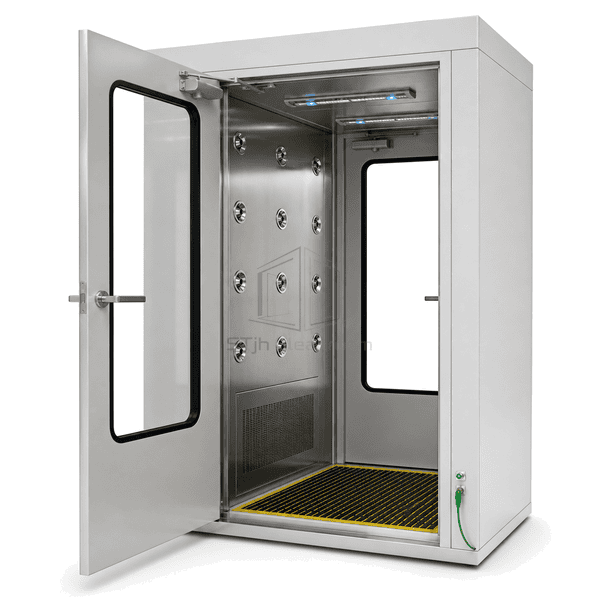
The ionizing cleanroom air shower is an enclosed personnel chamber with an entry door, a clean-side door and a controlled air cycle. A blower supplies filtered air to adjustable chamber nozzles, and return grilles lead the recirculating flow back through the filtration package. A selected ionizing grid or bar module introduces ions into the occupied air path. The enclosure, air-cleaning circuit and ionizer are specified together, with service access to the filter, blower and emitter areas.
The closed entry sequence gives the wearer a repeatable opportunity to turn and expose garment surfaces to the selected outlets.
The ionizer addresses electrostatic attraction while the air jets provide the separate mechanical action needed to loosen particles.
Outlet orientation can be matched to the standing area instead of treating every chamber position as equally exposed.
Accessible emitter locations support inspection and cleaning without treating a running blower as proof that the ionizer is effective.
Static-sensitive entry needs more than a stronger air blast or a grounded metal cabinet.
Suitable selection tasks involve dry personnel entry where both loose garment particles and electrostatic attraction are relevant. The ionizing option complements, rather than replaces, the area's gowning and ESD-control measures.
These are common selectable references for a compact enclosed personnel air shower with an ionizing option. Base-chamber sizes and operating ranges describe available configuration families, not a measured STjh model or one combined airflow, electrical and static-control rating.
| Enclosure Material Options | Powder-coated steel enclosure; SUS 304 stainless steel lining or casing optional |
|---|---|
| Compact Overall Size References | Approximately 1260–1290 mm wide × 1000 mm deep × 2055–2100 mm high |
| Compact Chamber Size References | Approximately 790–800 mm internal width, 910–1000 mm depth and 1980–2000 mm height |
| Occupancy Reference | Single-person compact chamber; longer personnel chambers optional |
| Air Circuit | Blower-driven recirculation through chamber returns, prefilter and final filter |
| Nozzle Arrangement | Adjustable side-wall air nozzles |
| Nozzle Velocity Reference | 20–25 m/s at the nozzle outlet, selectable base-shower reference |
| Final Filter Options | HEPA H13 or H14 element with a replaceable prefilter |
| Ionization Package | Ionizing grid or bar module integrated with the chamber air path |
| Blowing Timer Reference | 10–99 s adjustable blowing interval |
| Electrical Supply Reference | 380 V AC, 50 Hz; alternative voltage and frequency variants optional |
| Door and Sequence Controls | Two-door interlock, presence sensing and timed shower operation |
| Dienstzugang | Filter and blower access panels with accessible ionizer emitter locations |
| Customisierung | Verfügbar je nach beabsichtigter Anwendung und Betriebsumgebung. |
The usual starting arrangement is a two-door personnel chamber with blower-driven filtered jets and a timed interlock sequence. The ionizing module is the defining added package for this version; its technology, mounting and controls are identified separately from the enclosure material and filtration selection. Dimensions and configuration can be customized.
Identify the garments, carried items and surfaces on which charge is a concern. Choose the ionizer technology, location and working distance around the occupied chamber and its airflow. The selected module's charge-decay and offset-voltage behaviour must be evaluated at the intended positions; neither a power-on lamp nor an ionizing product name establishes those results. Do not use an ionizer as a replacement for the facility's personnel-grounding and ESD-control routine.
Allow space to turn without shielding garment surfaces or obstructing the return grilles. Distinguish overall enclosure dimensions, clear chamber space and the net door opening. Match the door swing, threshold and permitted occupants to the entry route, and reserve access for withdrawing the filters and servicing the ionizer. The compact references are not a drawing for the ordered equipment.
Ionization addresses surface charge, directed filtered air dislodges loose garment particles, and the return/filter circuit recirculates that air. Electrical earthing of the equipment and any specified bonding are separate from neutralizing charge on insulating clothing. A steel floor, stainless nozzle or ordinary powder coating does not by itself establish static-dissipative performance. Where the principal requirement is a stainless enclosure, compare the material scope of the SUS 304 stainless steel air shower.
Set the entry direction, sensor start, blowing interval, door release and emergency response as one operating sequence. Select the blower, filters and ionizer on the same supplied arrangement, including electrical load and access clearances. Qualified personnel should isolate the ionizer before emitter inspection or cleaning and follow the selected module's instructions. This dry garment-cleaning chamber is not a sterilizer, a respirable-hazard containment booth or equipment for an explosive atmosphere.
Senden Sie uns Ihre Abmessungen, Installationsbedingungen, Leistungsziele und gewünschte Oberflächenveredelung.