
 Englisch
 Portugiesisch
 Spanisch
 Malaiisch
 indonesisch
 DeutschCurrent
 Türkischer Sprache
 Vietnamesisch
 Französisch
 Russisch
 Arabisch
 Thailändisch
 Japanisch
 Koreanisch


Reinraumbekleidung, PPE und Verbrauchsmaterialien
Antistatische Finger Cots
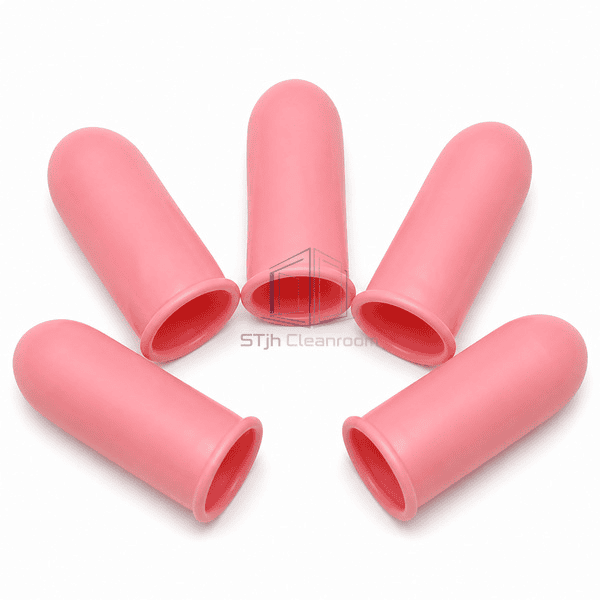
Pink powder-free antistatic latex finger cots with smooth thin walls, rolled retaining rings and dissipative performance.
- Pink latex formulation for clear ESD identification
- Powder-free rolled design for precise fingertip work
- Dissipative surface helps limit charge accumulation
Produkteinführung
Antistatic Finger Cots combine localized contamination control with a dissipative latex formulation for handling electrostatic-sensitive parts. The pink color provides immediate visual identification at the workstation. Each smooth, powder-free sleeve covers one fingertip and uses a rolled base ring to stay secure while preserving unrestricted movement in the remaining fingers.
Key Features
Pink color distinguishes the product from ordinary natural latex cots
Thin elastic film maintains fingertip sensitivity
Powder-free processing reduces loose residue at the work surface
Rolled base ring supports fast donning and stable retention
Lösungen für Ihre Anwendung
ESD-sensitive handling requires localized covers that remain dissipative, clean and correctly fitted. A loose cot or inconsistent grounding practice can still expose components to contamination or charge.
Ordinary latex cots can accumulate charge during movement.Select a dissipative formulation and verify performance within the ESD program.
An incorrect diameter may slip or constrict the finger.Provide several internal diameters for a secure, comfortable fit.
Powder can transfer to connectors and optical surfaces.Use powder-free clean processing and sealed ESD-compatible bags.
Operators may confuse antistatic and general-purpose cots.Specify a consistent pink identification color at every workstation.
Typische Anwendungen
Suitable for PCB and semiconductor handling, photonics, microelectronics assembly, connector inspection, watchmaking, sensitive optical work and other electrostatic-protected production tasks.
Technische Parameter
These ranges describe common pink rolled antistatic latex finger cots. Electrical performance should be verified with the full workstation grounding system.
| Core Material | Natural rubber latex with antistatic additive |
|---|---|
| Panel Dicke | 0.10–0.13 mm single wall |
| Effektive Breite | 15–24 mm internal diameter by size |
| Maximale Länge | 75 mm |
| Stahl facing Dicke | 0mm; keine Stahl verblendung verwendet |
| Kerndichte | 920–960 kg/m³ compounded latex elastomer |
| Thermische Leitfähigkeit | 0.13–0.17 W/(m·K), formulation dependent |
| Oberfläche Finish | Pink, smooth and powder-free with dissipative surface |
| Gemeinsamer Typ | Nahtlose röhrenförmige Kinder bett mit gerolltem Halte ring |
| Customisierung | Verfügbar je nach beabsichtigter Anwendung und Betriebsumgebung. |
Verfügbare Optionen
Small through extra-large internal diametersPink, black or white ESD identification color63 mm, 65 mm or 70 mm nominal lengthRolled or cut-edge formLatex or synthetic nitrile formulationESD-safe clean-packed bags
Planning a Antistatic Finger Cots specification?
Senden Sie uns Ihre Abmessungen, Installationsbedingungen, Leistungsziele und gewünschte Oberflächenveredelung.